
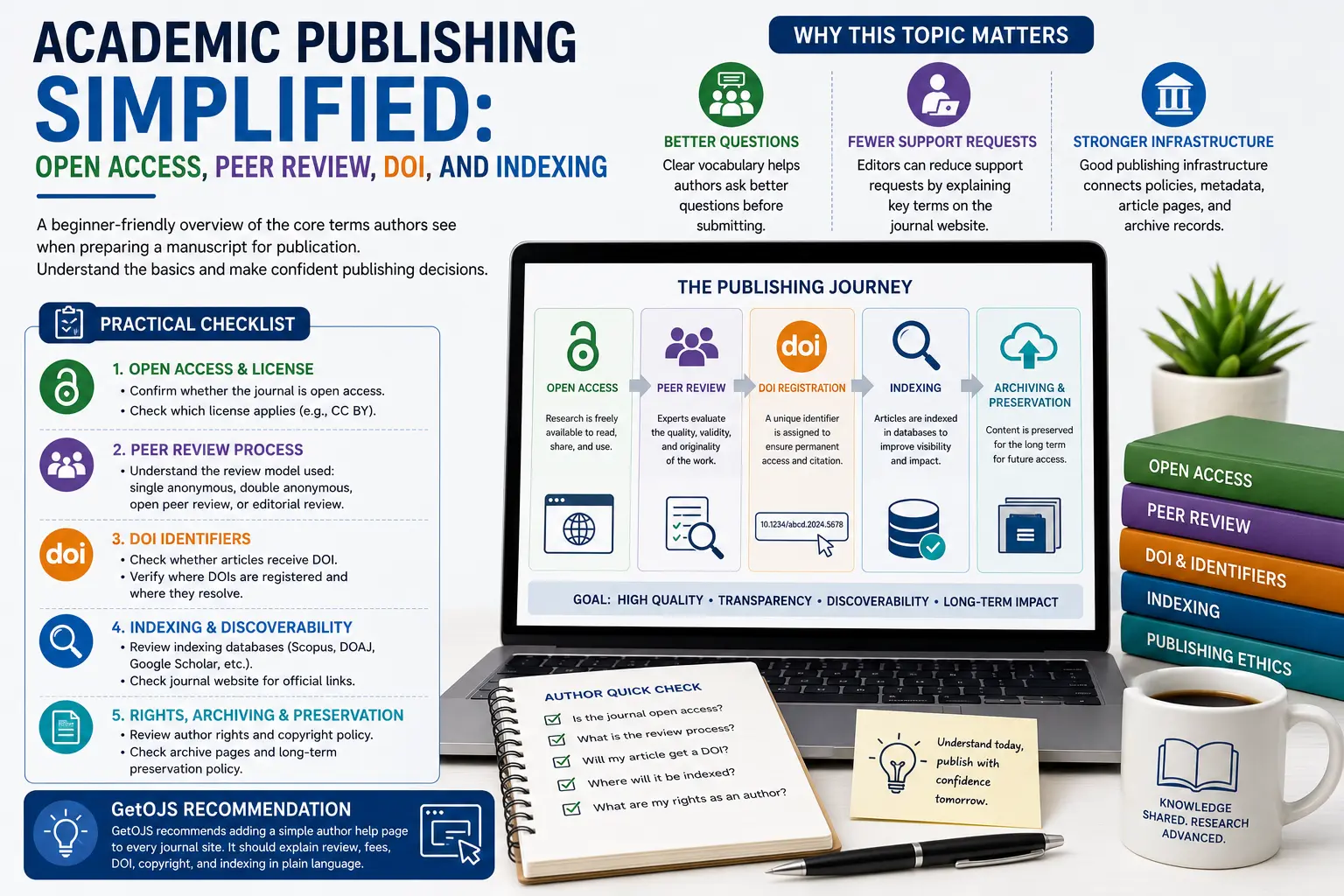
Academic publishing can feel confusing for new authors because it includes many technical terms such as open access, peer review, DOI, copyright, indexing, metadata, article processing charges, and journal archiving. Once these concepts are understood in simple language, researchers can choose better journals, prepare stronger manuscripts, avoid misleading publication claims, and publish their work with more confidence.
Introduction: Why Academic Publishing Needs to Be Simple
For many students, research scholars, faculty members, and early-career researchers, academic publishing begins with one question: where should I submit my paper? The answer is not always easy. A journal may look professional, but authors still need to understand whether it is peer reviewed, whether articles are open access, whether papers receive DOI links, whether the journal is indexed, and whether the publishing process follows ethical standards.
Academic publishing is not only about placing a research paper online. A good journal provides a complete scholarly communication system. It receives manuscripts, checks suitability, manages peer review, records editorial decisions, publishes final articles, creates article metadata, registers DOI links where applicable, preserves archives, and helps readers discover published work through search engines and indexing databases.
This beginner-friendly guide explains the most important publishing terms in simple language so authors and journal teams can make informed decisions before submission or publication.
What Is Academic Publishing?
Academic publishing is the process of sharing research findings through scholarly journals, conference proceedings, books, or institutional platforms. In journal publishing, authors submit manuscripts to a journal. Editors review the submission, send suitable papers to reviewers, make decisions, and publish accepted articles after copyediting, proofreading, formatting, and metadata preparation.
The purpose of academic publishing is to make research available to the right audience. A well-published article can help other researchers build on existing knowledge, support teaching and learning, contribute to policy decisions, and increase the academic visibility of authors and institutions.
What Is Open Access?
Open access means that published research is available online for readers without subscription barriers. In traditional subscription publishing, readers or institutions may need to pay to access articles. In open access publishing, the article can usually be read by anyone with an internet connection.
Open access is useful because it improves the reach of research. Students, independent researchers, professionals, policymakers, and institutions with limited library budgets can access research without paying for every article. For authors, open access can improve readership, sharing, and long-term visibility.
However, authors should carefully review the journal's open access policy. Some journals charge an article processing charge, also known as APC. Some offer free publication. Some use Creative Commons licenses, while others use custom copyright terms. Before submission, authors should check publication fees, refund policies, copyright transfer requirements, license details, and author rights.
Common Open Access Models
- Gold Open Access: Articles are freely available on the journal website immediately after publication.
- Diamond Open Access: Articles are free to read and authors are not charged publication fees.
- Hybrid Open Access: A subscription journal allows individual articles to be published open access after payment.
- Green Open Access: Authors may archive an accepted or published version in a repository according to the journal policy.
What Is Peer Review?
Peer review is the quality-checking process used by scholarly journals. After an editor receives a manuscript, the paper may be sent to experts in the same or related field. These reviewers evaluate the research question, methodology, originality, references, clarity, data presentation, ethical compliance, and contribution to the subject area.
Peer review does not guarantee that every published article is perfect, but it helps improve research quality and protects the credibility of the journal. A strong review process gives authors useful feedback and helps editors make fair publication decisions.
Main Types of Peer Review
- Single-anonymous review: Reviewers know the authors, but authors do not know the reviewers.
- Double-anonymous review: Reviewers and authors do not know each other's identities during review.
- Open peer review: Reviewer identity, review comments, or review history may be visible depending on the journal policy.
- Editorial review: Editors assess the work directly, often for short communications, editorials, or invited content.
What Is a DOI?
A DOI, or Digital Object Identifier, is a permanent digital identifier assigned to scholarly content such as journal articles, conference papers, datasets, books, and reports. A DOI helps readers find an article even if the website URL changes in the future. For example, when an article has a DOI, the DOI should lead to the article landing page where title, authors, abstract, journal name, publication date, and other metadata are available.
DOIs are important because they support reliable citation, long-term article linking, metadata exchange, indexing, and academic tracking. Many journals use Crossref DOI registration for scholarly articles. When a journal registers DOI links correctly, article metadata becomes easier for databases, libraries, search engines, and reference managers to process.
Authors should remember that a DOI is not the same as indexing. A DOI provides a persistent identifier, while indexing means the article or journal is included in a database. Both are useful, but they serve different purposes.
What Is Journal Indexing?
Journal indexing means that a journal or its articles are included in a recognized database, directory, search platform, or subject-specific discovery system. Indexing helps readers find published research. It also helps authors demonstrate the visibility and reach of their work.
Examples of discovery and indexing platforms may include Google Scholar, Crossref metadata search, DOAJ, Scopus, Web of Science, PubMed, subject databases, institutional repositories, and national journal lists. Each database has its own selection rules, evaluation process, and coverage policy. A journal may be visible in one database but not another.
Authors should verify indexing claims carefully. They should check the exact journal title, ISSN, publisher name, coverage years, and current status in the official source. Old indexing claims, similar journal names, discontinued coverage, or cloned journal websites can mislead authors.
Open Access, DOI, and Indexing: How They Work Together
Open access makes the article easier to read. DOI registration makes the article easier to cite and locate permanently. Indexing makes the article easier to discover through databases and search platforms. These three elements work best when the journal also maintains accurate metadata, ethical editorial policies, stable archive pages, and clear author guidelines.
For example, an open access article with a DOI and complete metadata has a stronger chance of being discovered by readers than a poorly formatted article with missing author details, unclear references, and no stable landing page. Good publishing infrastructure is therefore as important as the article PDF itself.
Important Metadata Every Article Should Have
- Article title, subtitle, and short running title where required.
- Author names, affiliations, country, and corresponding author email.
- ORCID IDs for authors, where available.
- Abstract, keywords, subject category, and article type.
- Publication date, volume, issue, page number or article ID.
- DOI link, references, funding statement, and conflict of interest statement.
How Authors Can Choose a Reliable Journal
Before submitting a manuscript, authors should review the journal website carefully. A reliable journal clearly displays its aims and scope, editorial board, peer review policy, publication ethics, fees, contact information, archive, indexing information, and author guidelines. The submission process should be transparent, and the journal should not promise unrealistic acceptance or guaranteed indexing.
Authors should avoid journals that use misleading claims, fake impact factors, unclear editorial boards, very fast guaranteed publication, copied website content, hidden charges, or suspicious email invitations. A good journal focuses on quality, ethics, transparency, and long-term scholarly value.
Checklist Before Submitting Your Paper
- Check whether the journal scope matches your research topic.
- Read the peer review policy and expected review timeline.
- Confirm open access license, APC, copyright, and refund policy.
- Verify DOI and indexing claims using official records.
- Review previously published articles for quality and relevance.
- Prepare manuscript files, figures, references, declarations, and author metadata properly.
How OJS Helps Academic Publishing
Open Journal Systems, commonly known as OJS, helps journals manage the complete publishing workflow. It supports manuscript submission, editor assignment, peer review, copyediting, production, publication, issue management, metadata entry, email communication, and user roles. For universities, societies, and independent publishers, OJS provides a structured way to run a professional journal website.
When configured correctly, OJS can improve transparency for authors, reduce manual email tracking for editors, organize reviewer assignments, publish article landing pages, and maintain searchable archives. It also helps journal teams display policies, author guidelines, editorial board details, indexing information, and publication ethics in a professional format.
Common Mistakes New Authors Should Avoid
Many authors focus only on acceptance and forget to evaluate the publishing process. This can result in poor visibility, incorrect metadata, indexing confusion, or difficulty proving publication quality later. Authors should not submit to a journal only because it promises fast publication. They should check whether the journal follows proper peer review, uses clear policies, provides stable article pages, and maintains ethical standards.
Another common mistake is misunderstanding DOI and indexing. A DOI does not automatically mean that a journal is indexed in Scopus or Web of Science. Similarly, a journal website may mention indexing, but authors must confirm whether the claim is current and officially verifiable.
Frequently Asked Questions
Is open access publication good for authors?
Yes, open access can improve readership and visibility because readers can access articles without subscription barriers. Authors should still check the journal quality, review policy, fees, license, and indexing claims before submission.
Does peer review guarantee acceptance?
No. Peer review is an evaluation process. Reviewers may recommend acceptance, revision, or rejection based on quality, originality, methodology, clarity, and relevance.
Is a DOI the same as indexing?
No. A DOI is a permanent identifier for an article or scholarly object. Indexing means inclusion in a database or discovery platform. A paper can have a DOI without being indexed in a specific database.
Why is metadata important in academic publishing?
Metadata helps search engines, indexing databases, libraries, and citation tools understand and display article information correctly. Poor metadata can reduce discoverability and create citation errors.
Can OJS manage peer review and publication together?
Yes. OJS supports submission tracking, editorial workflow, peer review, copyediting, production, publication, metadata, user roles, and journal archive management.
GetOJS Recommendation
GetOJS recommends that every journal website include a simple author help page explaining open access, peer review, DOI, indexing, publication fees, copyright, licensing, and ethical policies in clear language. This improves author trust, reduces repeated support questions, and helps new researchers understand the publishing journey before submission.
Need help applying this to your journal?
Our team can help configure, migrate, secure, customize, or maintain your OJS journal website.