
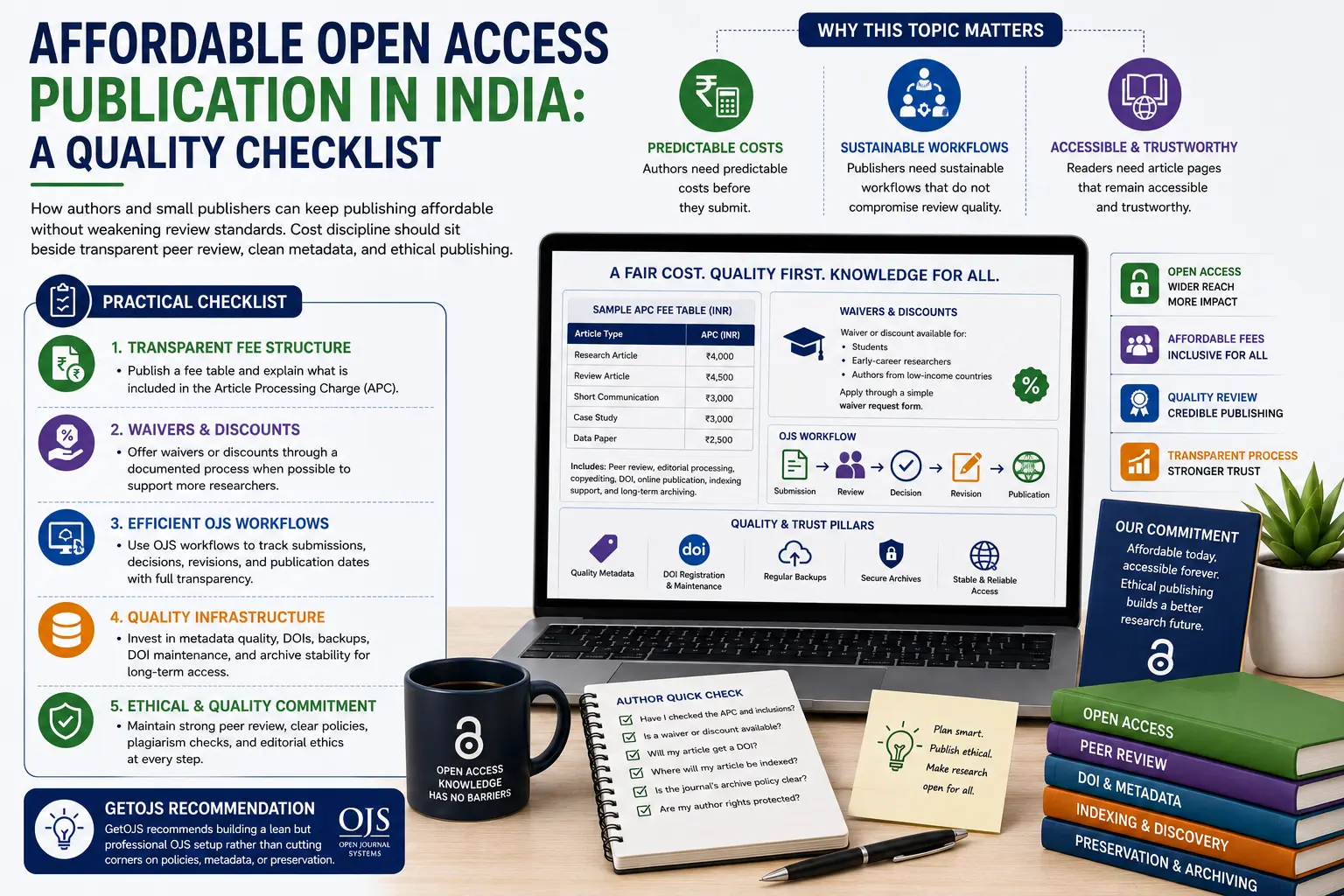
Affordable open access publication in India is important for students, research scholars, faculty members, universities, colleges, academic societies, and independent publishers. A lower publication cost can make research more accessible, but affordability should never mean weak peer review, unclear fees, poor metadata, or unreliable journal websites.
Understanding Affordable Open Access Publication in India
Open access publishing allows readers to access research articles online without subscription barriers. For Indian researchers, this model is especially useful because it helps articles reach a wider audience across universities, libraries, search engines, indexing databases, and global academic networks. However, many authors worry about article processing charges, journal quality, indexing claims, publication timelines, and whether the selected journal is suitable for academic evaluation.
An affordable open access journal should offer a clear balance between cost, quality, transparency, and long-term accessibility. The goal is not simply to find the lowest publication fee. The real goal is to select a journal that provides fair pricing, proper editorial screening, genuine peer review, strong publication ethics, accurate article metadata, stable article URLs, DOI support where applicable, and clear communication throughout the publication process.
Why Affordability Must Be Connected to Quality
Many early-career authors, PhD scholars, postgraduate students, and faculty members look for low-cost publication options because research budgets are often limited. This is understandable, but authors should carefully check whether the journal follows professional publishing standards. A very low fee may look attractive, but if the journal does not provide proper peer review, indexing clarity, plagiarism screening, archiving, DOI registration, or editorial support, the publication may create problems later.
For publishers, affordability should come from efficient workflow management rather than cutting essential quality steps. A well-configured Open Journal Systems (OJS) website can reduce manual work, organize submissions, track revisions, manage editorial decisions, publish clean article pages, and maintain an archive. This helps journals keep publication costs reasonable while still following professional standards.
Key Benefits of Affordable Open Access Publishing
- It allows more researchers from small colleges, regional institutions, and independent research groups to share their work.
- It improves article visibility because readers can access the full text without a paid subscription.
- It supports academic collaboration across cities, states, institutions, and subject areas.
- It helps journals build readership, citations, and long-term digital presence.
- It gives authors a practical publication route when funding is limited.
Quality Checklist Before Selecting an Affordable Journal
Before submitting your manuscript, review the journal carefully. Do not rely only on claims written on the homepage. Check the journal website, editorial board, author guidelines, publication ethics page, indexing page, contact details, archive, article metadata, and recent issue quality.
- Check whether the journal clearly displays its aims and scope.
- Verify the editorial board members and their subject expertise.
- Read the peer review policy and expected review timeline.
- Check whether publication fees are mentioned clearly before submission.
- Review published articles for formatting, references, DOI, metadata, and author information.
- Confirm whether the journal provides archive stability and permanent article URLs.
Transparent Article Processing Charges
A professional journal should clearly mention its article processing charge, what is included in the fee, when payment is required, and whether any refund or waiver policy applies. Authors should be cautious if a journal hides the fee until after acceptance or changes the amount during the process.
A good fee page should explain whether the charge includes peer review management, copyediting, layout preparation, DOI registration, XML or metadata support, indexing submission, website maintenance, long-term hosting, and article archiving. Clear pricing builds author trust and reduces confusion.
Peer Review Should Never Be Skipped
Affordable publication does not mean instant publication. A reliable journal should screen every manuscript for scope, originality, structure, references, plagiarism risk, and academic contribution. After editorial screening, suitable manuscripts should be sent for peer review by qualified reviewers.
Authors should avoid journals that promise guaranteed acceptance, same-day publication, or publication without review. Fast processing is possible when editorial workflows are well organized, but genuine peer review still requires time, reviewer availability, and editorial decision-making.
Indexing Claims Must Be Verified
Indexing is one of the most misunderstood parts of journal publishing. Many authors search for Scopus indexed journals, UGC-related journals, Google Scholar indexed journals, Web of Science journals, DOI journals, or open access journals in India. While indexing can improve discoverability, authors should verify each claim from official sources where possible.
Do not trust only logos displayed on a journal website. Check whether the journal title, ISSN, publisher name, and coverage years match official records. If the journal says it is indexed, the indexing page should provide accurate and current information. Incorrect indexing claims can mislead authors and damage publisher credibility.
DOI and Metadata Quality
A DOI is a persistent identifier that helps readers, databases, and citation tools locate an article. Not every affordable journal must have DOI support, but if a journal claims to provide DOI, the DOI should resolve correctly to the article page. The article title, author names, abstract, references, and publication date should be entered accurately.
Good metadata improves the chance that articles are discovered through Google Scholar, Crossref, search engines, institutional repositories, and indexing services. Poor metadata may reduce visibility even when the research itself is strong.
Website Quality and Long-Term Access
A journal website is more than a design element. It is the public record of published research. A good open access journal website should be mobile responsive, secure, easy to navigate, and structured with clear pages for current issue, archives, author guidelines, publication ethics, editorial board, contact, fees, indexing, and submission instructions.
For Indian publishers, using OJS can make the publishing process more professional. OJS supports submissions, review, editorial decisions, issue publication, article pages, galley files, metadata, email notifications, user roles, and archives. This helps small and mid-sized publishers maintain quality without building everything manually.
Red Flags Authors Should Avoid
- Guaranteed acceptance without review.
- No clear editorial board or fake-looking editor profiles.
- Hidden publication charges or sudden fee changes.
- False or unclear indexing claims.
- Poorly formatted articles with missing metadata.
- No plagiarism, ethics, correction, or retraction policy.
- No stable archive or broken article links.
Checklist for Publishers Offering Affordable Open Access
Publishers who want to offer affordable open access publication in India should focus on lean but reliable systems. Instead of reducing quality, they should reduce unnecessary manual work through better workflows, automation, clear templates, and trained editorial teams.
- Use a structured journal management system such as OJS.
- Publish clear author guidelines, review policy, fee policy, and ethics policy.
- Maintain accurate editorial board details and reviewer workflows.
- Use consistent article templates and metadata standards.
- Provide stable archives, backups, security updates, and DOI maintenance where applicable.
Frequently Asked Questions
Is affordable open access publication reliable?
Yes, affordable open access publication can be reliable when the journal follows peer review, ethical publishing, clear fee disclosure, proper metadata, and stable archiving. Authors should evaluate quality instead of choosing only by price.
Should authors choose the cheapest journal?
No. The cheapest option is not always the best option. Authors should compare fee transparency, editorial quality, review process, indexing claims, DOI support, website stability, and article quality before submission.
Can Indian journals provide international visibility?
Yes. Indian open access journals can reach international readers if they maintain strong metadata, publish quality research, follow ethical standards, use stable article URLs, and improve indexing readiness.
Does OJS help reduce publishing costs?
OJS can help publishers manage submissions, reviews, publication files, users, issues, and archives efficiently. This reduces manual work and supports affordable but professional journal operations.
GetOJS Recommendation
GetOJS recommends building a lean but professional OJS setup rather than cutting corners on policies, metadata, peer review, or preservation. Affordable publication should be supported by transparent processes, accurate article records, and reliable technical infrastructure.
For authors, the best approach is to look for a journal that is affordable, transparent, ethical, and suitable for your subject area. For publishers, the best approach is to invest in a strong workflow that keeps costs manageable while protecting academic quality.
Need help applying this to your journal?
Our team can help configure, migrate, secure, customize, or maintain your OJS journal website.