
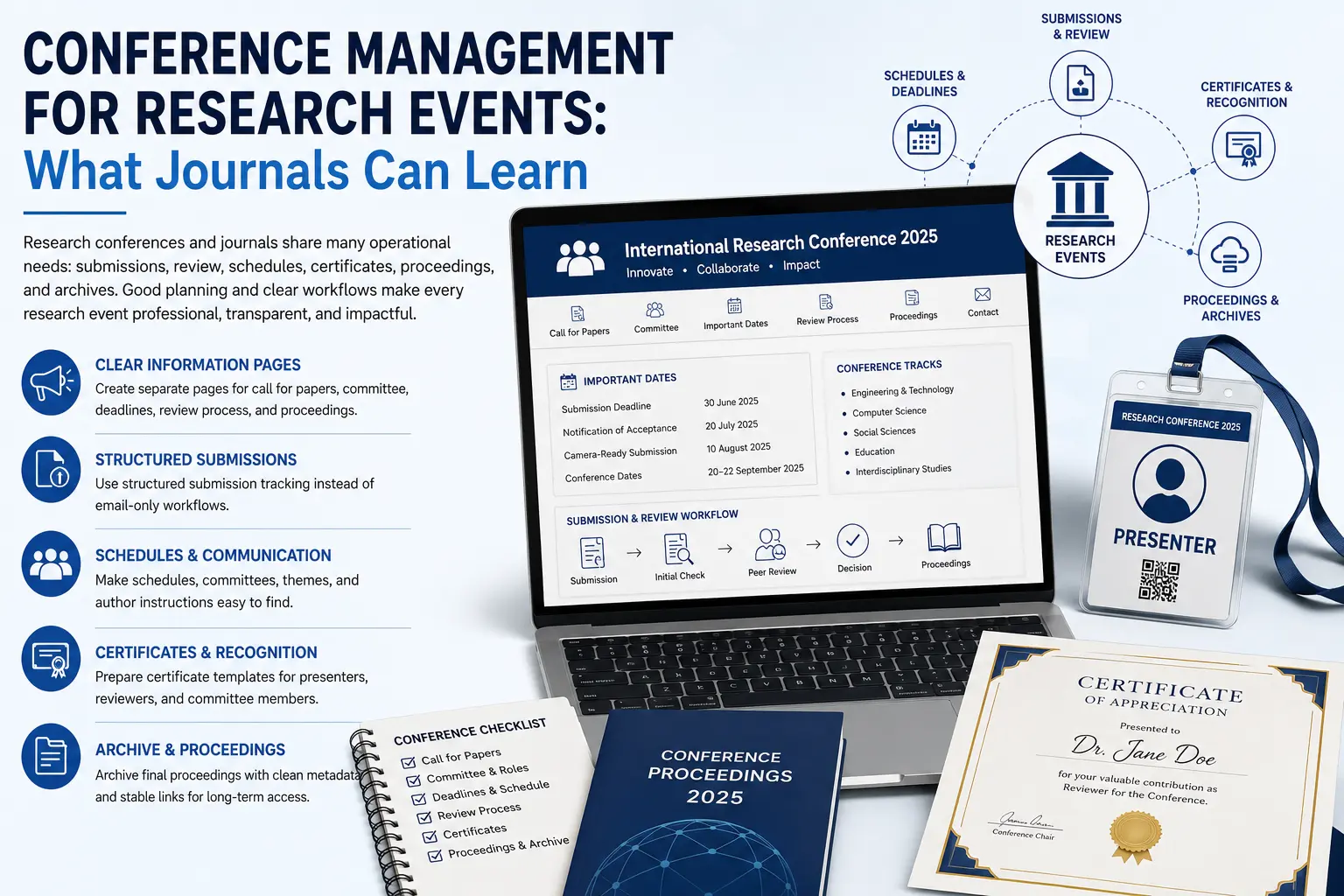
A conference is not a journal, but both depend on the same publishing discipline: structured submissions, timely review, clear communication, reliable metadata, public schedules, certificates, proceedings, and long-term digital archives. Research journals can learn a lot from conference management because conferences work with strict deadlines, fast editorial decisions, large author groups, and visible event outcomes.
Conference Management for Research Events: Why It Matters
Academic conferences are important platforms for researchers, students, faculty members, institutions, professional bodies, and industry experts. They bring together new ideas, early-stage findings, technical papers, posters, keynote lectures, workshops, panel discussions, and networking opportunities. A well-managed conference does not only depend on good speakers; it depends on a complete workflow that begins with a call for papers and continues through submission, peer review, registration, scheduling, presentation, certification, publication, and archiving.
Research journals face many of the same operational challenges. They also receive manuscripts, assign reviewers, track revisions, communicate decisions, prepare metadata, publish articles, and preserve archives. The main difference is speed. Conferences usually work on a fixed event date, so every task must be planned with clear deadlines. Journals can use this conference-style discipline to improve editorial workflow, reduce delays, and create a better experience for authors, reviewers, and readers.
What Journals Can Learn from Conference Workflows
Conference teams are usually very deadline-focused. They announce submission dates, review deadlines, acceptance dates, registration deadlines, camera-ready paper dates, and event schedules in advance. This creates clarity for authors and helps the organizing committee manage work in a structured way. Journals can apply the same method by defining expected timelines for initial screening, peer review, revision, copyediting, production, and publication.
For journals, clear timelines improve trust. Authors want to know when their paper will be reviewed, when they may receive a decision, and what happens after acceptance. A journal website that explains the editorial process clearly looks more professional and reduces repeated support queries.
Key Similarities Between Conferences and Journals
- Both require a clear submission system with author details, title, abstract, keywords, and file uploads.
- Both need qualified reviewers or committee members to evaluate research quality.
- Both depend on transparent communication between authors, editors, reviewers, and organizers.
- Both need structured metadata for discoverability, indexing, citation, and long-term access.
- Both must maintain ethical standards, plagiarism checks, conflict disclosures, and publication integrity.
1. Clear Call for Papers and Author Guidelines
A successful research event begins with a strong call for papers. The call for papers should explain the theme, subject tracks, important dates, paper format, review criteria, publication opportunities, registration requirements, and contact details. Journals can use the same approach in their author guidelines. Instead of writing short and unclear instructions, journals should provide detailed submission requirements, article types, formatting rules, ethical policies, reference style, metadata instructions, and publication charges if applicable.
When authors understand requirements before submission, the editorial team receives cleaner files and fewer incomplete manuscripts. This improves screening speed and helps reviewers focus on content quality instead of basic formatting problems.
2. Structured Submission Tracking
Email-only conference submissions can become confusing very quickly. Files get lost, versions become mixed, reviewers miss deadlines, and authors do not know the status of their papers. The same problem happens in journal publishing when manuscripts are managed manually through email or spreadsheets.
A proper conference management platform or journal management system solves this problem by creating a complete submission trail. Every paper receives a tracking ID, authors can upload revised files, reviewers can submit comments, editors can record decisions, and administrators can monitor progress. For journals using Open Journal Systems (OJS), this structured workflow is one of the strongest advantages because the full editorial process can be managed from submission to publication.
3. Reviewer Assignment and Review Quality
Conference organizers often work with large technical committees and subject experts. They assign reviewers based on topics, keywords, tracks, and expertise. Journals should follow a similar approach by maintaining a reviewer database with subject areas, previous review history, response time, and quality of review comments.
Good reviewer management helps avoid delays and improves decision quality. Reviewers should receive clear evaluation criteria, deadlines, confidentiality instructions, and conflict-of-interest guidance. Journals that treat reviewer coordination seriously can improve peer review transparency and author satisfaction.
4. Deadline-Based Editorial Planning
One of the strongest lessons journals can learn from conferences is deadline discipline. Conferences cannot delay endlessly because the event date is fixed. This forces organizers to plan backward from the final date: paper submission, review, acceptance, registration, schedule preparation, certificate generation, and proceedings publication.
Journals can apply a similar planning model even when publishing continuously. For example, a journal may define expected timelines such as seven days for initial screening, four weeks for peer review, two weeks for revision, and two weeks for production after acceptance. These are not strict promises, but they give authors realistic expectations and help editorial teams measure workflow performance.
5. Public Pages, Schedules, and Communication
Conference websites usually include dedicated pages for call for papers, important dates, committees, speakers, registration, venue, schedule, publication partners, and contact information. Journals can improve their websites by using the same clarity. Important pages such as About the Journal, Aims and Scope, Editorial Board, Peer Review Policy, Ethics Policy, Author Guidelines, Publication Charges, Indexing, Archives, and Contact should be easy to find.
A clear website builds credibility. Many authors judge a journal by its public presentation before submitting. If pages are incomplete, outdated, or difficult to navigate, authors may lose trust. Good conference websites show how strong content organization can improve user experience.
6. Certificates, Acknowledgements, and Recognition
Conferences often provide certificates for presenters, participants, reviewers, keynote speakers, session chairs, and committee members. This recognition motivates academic participation and creates professional value. Journals can learn from this by recognizing reviewers and editorial contributors in appropriate ways.
Reviewer certificates, acknowledgement pages, annual reviewer lists, and editorial contribution records can help journals build a stronger academic community. These practices also encourage reviewers to continue supporting the publication.
7. Proceedings, Archives, and Long-Term Access
Conference proceedings are the final published record of a research event. They must be organized carefully with titles, authors, abstracts, keywords, page numbers, ISBN or DOI information where applicable, and stable online links. Journals already understand archiving, but conferences highlight the importance of publishing complete records quickly and accurately.
For both journals and conferences, long-term access is essential. Broken links, missing files, incorrect metadata, and poorly organized archives reduce credibility. A professional publishing platform should preserve published work with stable URLs, clean metadata, downloadable files, and search-friendly article pages.
8. Metadata and SEO for Research Visibility
Research visibility depends heavily on metadata. Every conference paper or journal article should include a clear title, abstract, author names, affiliations, keywords, references, DOI if available, and publication details. Search engines, Google Scholar, Crossref, indexing databases, institutional repositories, and citation platforms use metadata to understand and display research content.
For SEO, the title should include important subject terms, the abstract should describe the research clearly, and keywords should match real search behavior. Journal and conference websites should also use proper page titles, meta descriptions, canonical URLs, Open Graph tags, image alt text, and structured internal links. These small technical details can make a large difference in discoverability.
9. Ethical Standards and Research Integrity
Both conferences and journals must protect academic integrity. Submission systems should support plagiarism checks, conflict-of-interest declarations, authorship confirmation, ethical approval statements, copyright permissions, and transparent review policies. If a conference publishes proceedings or if a journal publishes special issues from conference papers, ethical checks become even more important.
Journals should clearly explain how conference papers are handled. If extended versions of conference papers are accepted, the journal should require substantial new content, proper citation of the original conference version, and full disclosure from authors. This prevents duplicate publication and protects the reputation of the journal.
10. Using Technology to Manage Research Events and Journals
Modern publishing work requires more than a simple website. Conference organizers need tools for submission collection, reviewer assignment, registration, payment tracking, agenda management, certificate generation, proceedings publication, and communication. Journals need tools for manuscript submission, editorial decisions, peer review, copyediting, DOI management, indexing preparation, and archive publication.
Platforms such as conference management systems, Open Journal Systems, DOI registration tools, and journal hosting services help institutions work professionally. The right platform reduces manual work, improves transparency, and allows teams to focus on academic quality instead of repetitive administration.
Practical Checklist for Research Event and Journal Teams
- Create separate pages for call for papers, committee, deadlines, review process, registration, certificates, and proceedings.
- Use a structured submission system instead of managing manuscripts only through email.
- Define review criteria, reviewer deadlines, acceptance rules, and revision requirements before submissions begin.
- Prepare certificate templates for presenters, reviewers, keynote speakers, session chairs, and committee members.
- Publish proceedings or journal articles with clean metadata, stable URLs, and DOI links where applicable.
- Maintain transparent communication with authors at every major stage of the workflow.
- Archive final content properly so that readers can access it after the event or publication cycle.
How GetOJS Can Help
GetOJS recommends choosing journal or conference infrastructure based on the final publication goal. If your main output is a journal issue, the workflow should be planned around editorial review, production, DOI, indexing, and archives. If your main output is a research event, the workflow should include call for papers, tracks, committees, registration, schedules, certificates, and proceedings. In many cases, universities and academic societies need both systems to work together.
With the right setup, a conference can collect papers professionally, review them efficiently, publish selected papers as proceedings, and later invite extended versions for journal publication. This creates a smooth academic publishing ecosystem that supports authors, reviewers, editors, and institutions.
Need help applying this to your journal or conference?
Our team can help configure, migrate, secure, customize, or maintain your OJS journal website and research event workflow.
Frequently Asked Questions
What is conference management for research events?
Conference management is the process of organizing research event activities such as call for papers, paper submission, peer review, registration, scheduling, certificates, proceedings, and post-event archives.
How are conferences related to academic journals?
Both conferences and journals manage scholarly submissions, reviewer coordination, editorial decisions, metadata, publication records, and academic communication. Journals can learn from the deadline-based planning used by conferences.
Can conference papers be published in journals?
Yes, but journals should usually require extended versions with meaningful new content, proper citation of the original conference paper, and clear disclosure from the authors to avoid duplicate publication.
Why is metadata important for conference proceedings?
Metadata helps search engines, indexing services, repositories, and citation platforms discover, organize, and display published conference papers or journal articles correctly.
Conclusion
Conference management and journal publishing are closely connected parts of scholarly communication. Research events teach journals the value of planning, deadlines, structured workflows, strong communication, public schedules, certificates, metadata, and permanent archives. Journals teach conferences the importance of publication quality, ethics, peer review, DOI registration, indexing preparation, and long-term preservation.
When institutions combine the best practices of both models, they can create stronger research communities, improve publication quality, and deliver a better experience for authors, reviewers, participants, and readers. A modern publishing strategy should not treat conferences and journals as separate activities; it should connect them through reliable technology, transparent policies, and professional editorial management.