
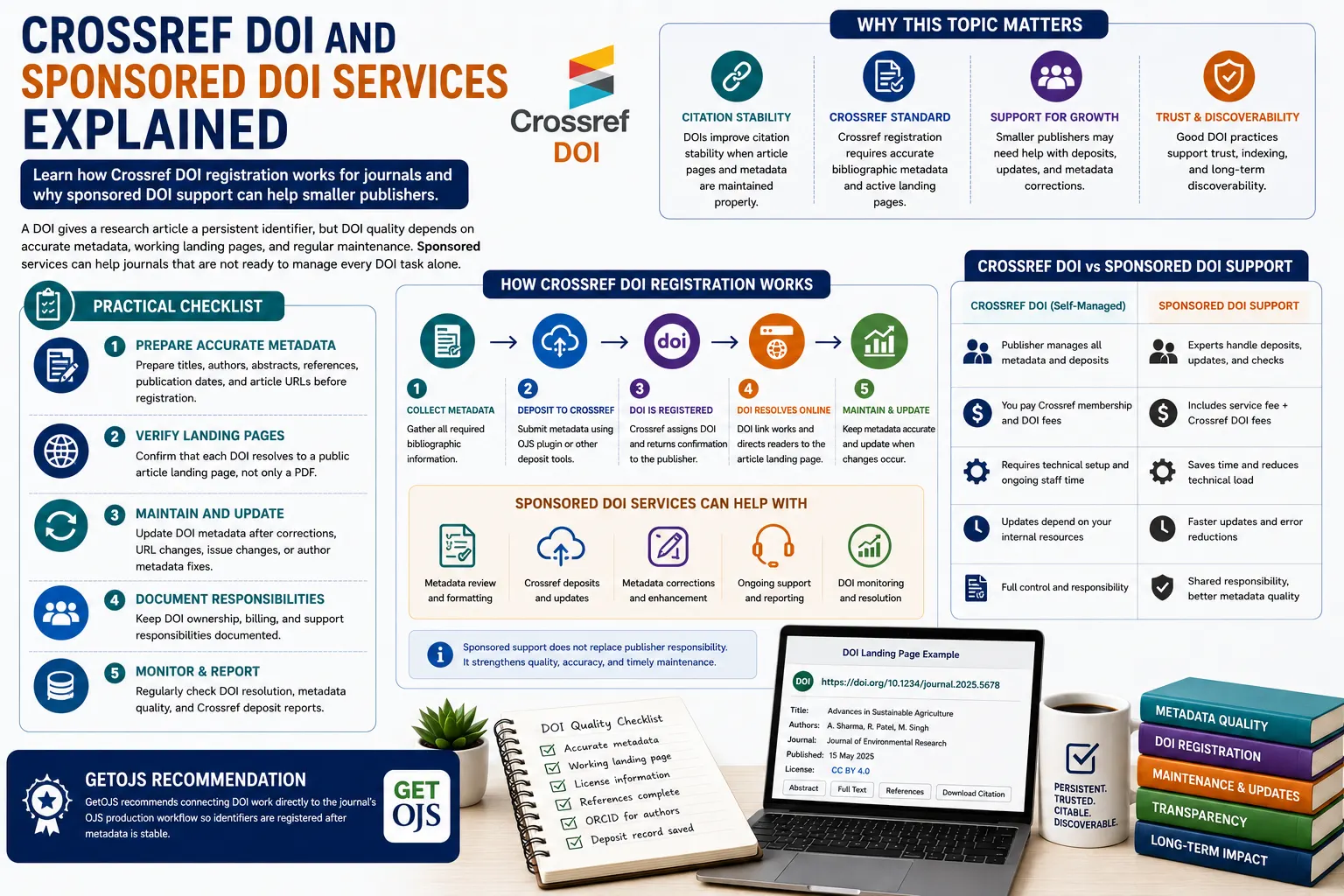
A DOI gives a research article a persistent digital identity, but DOI registration is not only about creating a clickable link. For journals, Crossref DOI registration connects article pages, metadata, authors, references, publication dates, funding information, and citation records into a more reliable scholarly communication system. Sponsored DOI services can help smaller publishers, societies, colleges, and independent journals manage this process without building every technical workflow from the beginning.
What Is a DOI?
A DOI, or Digital Object Identifier, is a permanent identifier assigned to a digital research object such as a journal article, conference paper, book chapter, dataset, preprint, or report. Unlike a normal website URL, a DOI is designed to remain stable even when the article page changes location. The DOI resolves to a landing page where readers can find the article title, authors, abstract, journal details, publication date, PDF link, license information, and citation details.
For authors, a DOI makes their work easier to cite and track. For journals, it improves article discoverability, supports citation linking, and gives published content a professional identity. For readers, it provides a dependable way to access the final published version of a research article.
What Is Crossref?
Crossref is one of the most widely used DOI registration agencies for scholarly and professional research content. Journals, publishers, universities, and research organizations use Crossref to register DOIs for journal articles and submit structured metadata. This metadata helps search engines, indexing platforms, citation tools, library systems, and academic databases understand the published record.
When a journal registers a Crossref DOI, it is not simply buying a number. The journal is creating a metadata record that should accurately describe the article. This record may include the article title, author names, journal title, ISSN, volume, issue, page numbers or article number, publication date, DOI, URL, references, ORCID IDs, funding details, abstracts, and license information.
Why Crossref DOI Registration Matters for Journals
Crossref DOI registration is especially important for academic journals that want to improve citation reliability and long-term visibility. A properly registered DOI connects the article to the wider scholarly ecosystem. It allows citation managers, indexing services, discovery tools, and academic search engines to retrieve article metadata more accurately.
- It gives every article a persistent identifier that can be cited globally.
- It improves metadata visibility for search engines and discovery platforms.
- It supports reference linking between articles, journals, and publishers.
- It helps authors present their publications in CVs, profiles, and institutional reports.
- It strengthens the journal’s professional publishing infrastructure.
What Are Sponsored DOI Services?
Sponsored DOI services are support arrangements where an experienced organization helps a journal or publisher register and manage DOIs under a supported workflow. This can be useful for smaller journals that are not yet ready to handle direct DOI membership, technical deposits, XML metadata preparation, OJS configuration, billing, and ongoing corrections independently.
A sponsored DOI service may help with DOI prefix setup, article metadata preparation, DOI suffix formatting, OJS DOI configuration, Crossref deposit support, article landing page checks, DOI activation, metadata updates, and troubleshooting. The goal is to make DOI registration easier while still maintaining accurate publishing records.
Who Needs Sponsored DOI Support?
Sponsored DOI support is useful for new journals, college journals, society journals, small publishers, conference proceedings publishers, and research organizations that want professional DOI registration but do not have a dedicated technical publishing team. It is also helpful when a journal uses Open Journal Systems but needs support configuring DOI plugins, generating suffix patterns, validating metadata, or fixing failed deposits.
However, sponsored support should not be treated as a shortcut for weak publishing practices. The journal must still maintain editorial quality, peer review records, ethical policies, correct metadata, public article pages, and stable archives.
Crossref DOI Workflow for a Journal Article
A strong DOI workflow begins before publication. The journal should first complete editorial acceptance, copyediting, proofreading, galley preparation, and metadata verification. Once the article title, authors, affiliations, abstract, keywords, publication date, and article URL are stable, the DOI can be registered and activated.
- Finalize the accepted article metadata inside the journal management system.
- Confirm the DOI pattern, article URL, publication date, volume, issue, and article number.
- Prepare a public article landing page with title, authors, abstract, PDF link, and citation details.
- Deposit article metadata with Crossref using a supported registration workflow.
- Test DOI resolution and correct metadata errors immediately if found.
Why DOI Landing Pages Are Important
Every DOI should resolve to a proper landing page, not directly to a PDF file. A landing page gives readers and indexing systems enough context about the article. It should show the article title, author names, journal name, abstract, keywords, publication date, license, DOI link, citation formats, and downloadable files. If a DOI resolves only to a PDF, metadata discovery and user experience become weaker.
For OJS journals, the article landing page is usually the best DOI target because it already contains structured article information, galley files, references, and citation tools. A stable landing page also makes it easier to update PDFs, add corrections, or improve metadata without changing the DOI itself.
Common DOI Metadata Mistakes
Many DOI problems happen because journals rush registration without checking details. Small mistakes can create long-term confusion in citation databases and academic profiles. Authors may notice spelling errors, wrong affiliations, missing ORCID IDs, incorrect issue details, broken URLs, or duplicate DOI records after publication.
- Registering a DOI before the final article page is ready.
- Using inconsistent author names across PDF, article page, and DOI metadata.
- Depositing the wrong volume, issue, page range, or article number.
- Forgetting to update DOI metadata after changing the article URL.
- Creating duplicate DOIs for the same article version.
How OJS Helps with DOI Management
Open Journal Systems can support DOI management when configured correctly. OJS allows journals to assign DOI patterns, display DOI links on article pages, manage publication metadata, and support deposit workflows through DOI-related plugins or export tools. For many journals, OJS becomes the central place where article information is prepared before DOI registration.
A clean OJS setup helps reduce DOI errors because metadata is already organized by journal, issue, article, author, and galley. Still, the system must be maintained carefully. Journal managers should check article metadata before publication, keep URLs stable, avoid deleting published article pages, and ensure that DOI prefixes and suffixes follow a consistent pattern.
What Should Be Included Before DOI Registration?
Before registering DOIs, journals should prepare complete article information. This avoids repeated corrections later and improves the usefulness of each DOI record.
- Journal title, ISSN, publisher name, and journal website URL.
- Article title, abstract, keywords, language, and article type.
- Author names, affiliations, emails where appropriate, and ORCID IDs.
- Volume, issue, year, page range or article number, and publication date.
- References, funding details, license terms, and article landing page URL.
Crossref DOI vs a Normal Website Link
A normal URL may change when a website is redesigned, migrated, or restructured. A DOI is designed to remain the permanent citation link even when the underlying URL changes. If a journal moves from one server to another or changes its OJS path, DOI metadata can be updated so the DOI continues resolving correctly.
This is why DOI maintenance is just as important as DOI registration. A DOI that points to a broken page creates frustration for authors and readers. Journals should regularly audit DOI links, especially after website migration, OJS upgrades, domain changes, or archive restructuring.
Quality Checklist for Sponsored DOI Services
Before choosing a sponsored DOI provider, journals should check what is included in the service. A reliable provider should explain the DOI workflow clearly and should not make unrealistic promises about indexing, impact factor, or guaranteed citations.
- Confirm who will prepare and verify article metadata.
- Ask how DOI suffixes will be formatted for issues and articles.
- Check whether metadata corrections are included after publication.
- Confirm whether OJS DOI setup, plugin support, and troubleshooting are covered.
- Ensure there is a clear process for DOI reports, failed deposits, and URL changes.
GetOJS Recommendation
GetOJS recommends connecting DOI registration directly with the journal’s production workflow. DOIs should be registered after the article metadata is stable, the landing page is public, and the publication details are final. For journals using OJS, DOI setup should be planned along with issue publication, article metadata review, and archive maintenance.
For smaller journals, sponsored DOI services can be a practical way to start DOI registration professionally. The best approach is to combine technical support with strong editorial policies, accurate metadata, transparent publication fees, and reliable hosting.
Frequently Asked Questions
What is a Crossref DOI?
A Crossref DOI is a persistent digital identifier registered through Crossref for scholarly content such as journal articles, conference papers, books, and other research outputs.
Can a small journal get DOI services?
Yes. Small journals can use direct DOI registration routes or sponsored DOI support depending on their technical capacity, publishing volume, and management needs.
Should a DOI point to the PDF or article page?
A DOI should normally point to the article landing page because it provides full metadata, citation details, abstract, files, and journal context.
Can DOI metadata be updated after publication?
Yes. DOI metadata should be updated whenever article URLs, author details, issue information, references, or publication metadata are corrected.
Does having a DOI guarantee indexing?
No. A DOI improves identification and citation linking, but indexing depends on the policies and evaluation criteria of each indexing database.
Need help applying this to your journal?
Our team can help configure, migrate, secure, customize, or maintain your OJS journal website.