
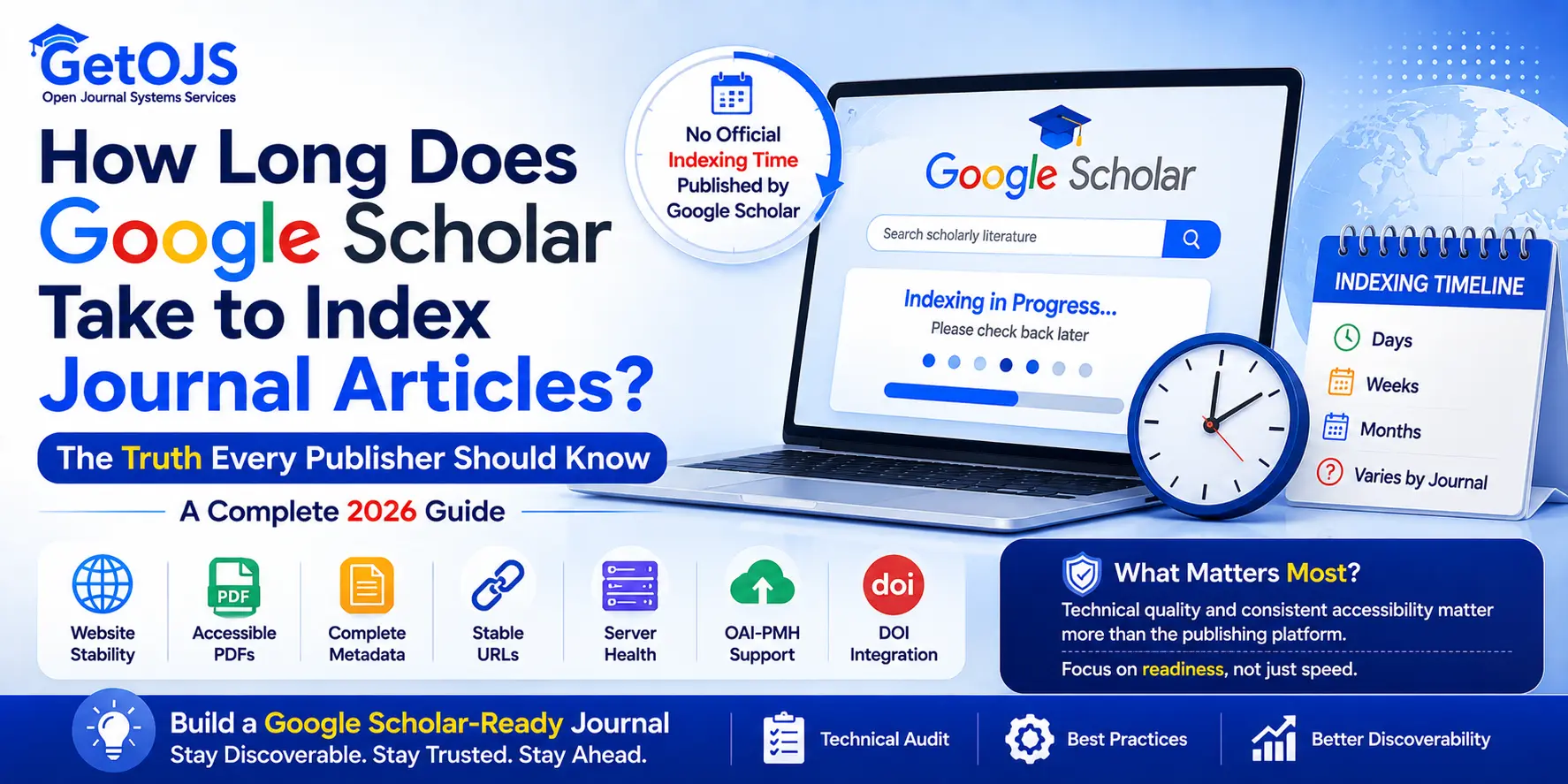
One of the most frequently asked questions by journal publishers is: “How long will Google Scholar take to index my articles?” Some editors expect indexing within a few hours, while others wait several months and begin wondering whether something is technically wrong with their journal.
The reality is that Google Scholar does not publish an official indexing timeline. Unlike many indexing databases, it does not tell publishers when articles will be crawled, reviewed, reprocessed or added to the index.
Understanding this process can help publishers make better decisions and avoid unnecessary website changes while waiting for Google Scholar to revisit their journal.
The Short Answer
Google Scholar does not publish a guaranteed indexing time.
Some journals report that new articles appear within days, while others observe much longer delays. Timing can depend on technical accessibility, website stability and Google Scholar's own crawl schedule.
Why Google Scholar Is Different
Google Search and Google Scholar are independent systems. Google Search gives publishers more direct tools for web discovery, while Google Scholar does not provide the same publisher-facing controls.
| Feature | Google Search | Google Scholar |
|---|---|---|
| Search Console | ✅ Available | ❌ Not available |
| Sitemap submission | ✅ Available | ❌ No dedicated tool |
| URL inspection | ✅ Available | ❌ Not available |
| Indexing request | ✅ Available in Search Console | ❌ Not available |
| Submission form | Not typically required | ❌ No formal journal submission form |
| Crawl reports | ✅ Available through Search Console | ❌ Not available |
| Published crawl schedule | ❌ No fixed schedule | ❌ No fixed schedule |
This means publishers cannot directly monitor or accelerate Google Scholar's indexing process in the same way they can interact with Google Search tools.
What Influences Google Scholar Indexing Time?
1. Website Stability
Stable websites with consistent availability are easier for crawlers to revisit. Frequent outages or major infrastructure changes can delay reprocessing.
2. Article Accessibility
Articles should:
- Be publicly available.
- Return HTTP 200 responses.
- Be accessible without authentication.
3. PDF Availability
Research articles should provide downloadable PDFs where appropriate. Broken or restricted PDF access can reduce discoverability.
4. Metadata Quality
Complete metadata helps Google Scholar interpret important article details such as:
- Title.
- Authors.
- Journal title.
- DOI.
- Volume.
- Issue.
- Publication date.
Incomplete metadata can make accurate bibliographic interpretation more difficult.
5. URL Stability
Changing article URLs after publication can require Google Scholar to rediscover the article. Stable URLs support long-term discoverability and continuity.
6. Website Changes
Major technical events may require Google Scholar to reassess the journal:
- OJS upgrades.
- Theme replacements.
- Domain migrations.
- Hosting migrations.
Why New Journals Often Wait Longer
New journals generally have:
- Fewer published articles.
- Limited citation history.
- Less established publishing patterns.
As a journal grows and publishes consistently, discoverability may improve over time.
Why Previously Indexed Articles Sometimes Disappear
Publishers are often surprised when articles that were previously visible in Google Scholar temporarily disappear.
Possible reasons include:
- Major website changes.
- Metadata revisions.
- URL restructuring.
- Extended downtime.
- Ongoing reprocessing by Google Scholar.
A temporary change in visibility does not always mean permanent loss of indexing.
Common Myths About Google Scholar Indexing Time
Myth 1: “I submitted my sitemap to Google Search Console, so Google Scholar should index immediately.”
Reality: Google Search Console supports Google Search, not Google Scholar.
Myth 2: “There is a button to request Google Scholar indexing.”
Reality: Google Scholar does not provide a publisher-facing indexing request feature.
Myth 3: “If my journal is not indexed within a week, something is broken.”
Reality: There is no universal indexing timeline.
Myth 4: “OJS guarantees Google Scholar indexing.”
Reality: OJS can produce technically compliant journal websites, but no journal management system can guarantee Google Scholar indexing.
What Publishers Should Do During an Indexing Delay
Instead of making repeated structural changes, publishers should focus on verifying the technical foundation of the journal.
- Verify article accessibility.
- Confirm PDF availability.
- Check metadata.
- Review DOI resolution.
- Ensure robots.txt allows crawling.
- Monitor website uptime.
- Continue publishing consistently.
Maintaining a stable environment is generally more productive than making continuous structural changes.
A Technical Audit Is Often More Valuable Than Guesswork
When articles do not appear in Google Scholar, publishers sometimes spend weeks experimenting with themes, plugins and server settings. A structured technical audit can identify whether genuine technical issues exist.
A technical audit can review:
- Metadata.
- HTTP responses.
- DOI configuration.
- PDF delivery.
- OAI-PMH.
- URL consistency.
- Robots.txt.
- Canonical URLs.
This provides evidence-based recommendations instead of trial and error.
How ScholarJMS Helps
ScholarJMS has been designed to simplify technical publishing while supporting recognized scholarly publishing practices.
- Structured Highwire metadata.
- DOI-ready article pages.
- Stable URL architecture.
- OAI-PMH support.
- Secure hosting.
- Editorial workflow management.
- Technical maintenance.
- Publishing support.
ScholarJMS cannot guarantee Google Scholar indexing, but it is designed to help publishers maintain a technically consistent publishing environment and reduce avoidable configuration issues.
When Should You Be Concerned?
It may be appropriate to investigate further if:
- Articles remain absent for an extended period.
- Previously indexed articles disappear permanently.
- Technical audits reveal metadata or accessibility problems.
- Server logs indicate repeated crawler errors.
In these situations, correcting verified technical issues is the appropriate first step.
Final Thoughts
Google Scholar's indexing process is independent and not fully transparent. Publishers cannot control exactly when Google Scholar revisits a journal, but they can ensure that their websites remain technically healthy, accessible and consistent.
The strongest long-term strategy is to combine solid editorial standards with a reliable publishing platform and avoid unnecessary technical changes while waiting for Google Scholar to reprocess new or updated content.
Why Publishers Choose ScholarJMS
ScholarJMS is a cloud-based journal management platform developed for modern scholarly publishing.
It combines:
- Editorial workflow.
- Peer review.
- DOI integration.
- OAI-PMH.
- Metadata automation.
- Secure hosting.
- Technical support.
- Platform maintenance.
- Journal migration.
- Publishing consultancy.
Whether you are launching a new journal or maintaining an established publication, ScholarJMS is designed to reduce technical complexity while allowing editors to focus on research quality and publishing excellence.
Frequently Asked Questions
How long does Google Scholar take to index journal articles?
Google Scholar does not publish a guaranteed indexing time. Some journals report articles appearing within days, while others experience much longer delays.
Does Google Scholar provide an indexing request tool?
No. Google Scholar does not provide publishers with a Search Console, indexing request tool, formal submission form, crawl report or published crawl schedule.
What can delay Google Scholar indexing?
Website instability, inaccessible articles, broken PDFs, incomplete metadata, URL changes, OJS upgrades, theme replacements, domain migrations and hosting migrations can all contribute to rediscovery or reprocessing delays.
Does OJS guarantee Google Scholar indexing?
No. OJS can produce technically compliant journal websites, but no journal management system can guarantee Google Scholar indexing.
What should I do if my article is not indexed yet?
Verify article access, PDF availability, metadata, DOI resolution, robots.txt, uptime, URL stability and other technical factors. Avoid making unnecessary repeated changes if the journal is already technically healthy.
Still Waiting for Google Scholar to Index Your Journal?
Our technical team can review metadata, DOI resolution, PDF accessibility, HTTP responses, robots.txt, OAI-PMH, URL structure, canonical URLs and overall indexing readiness.