
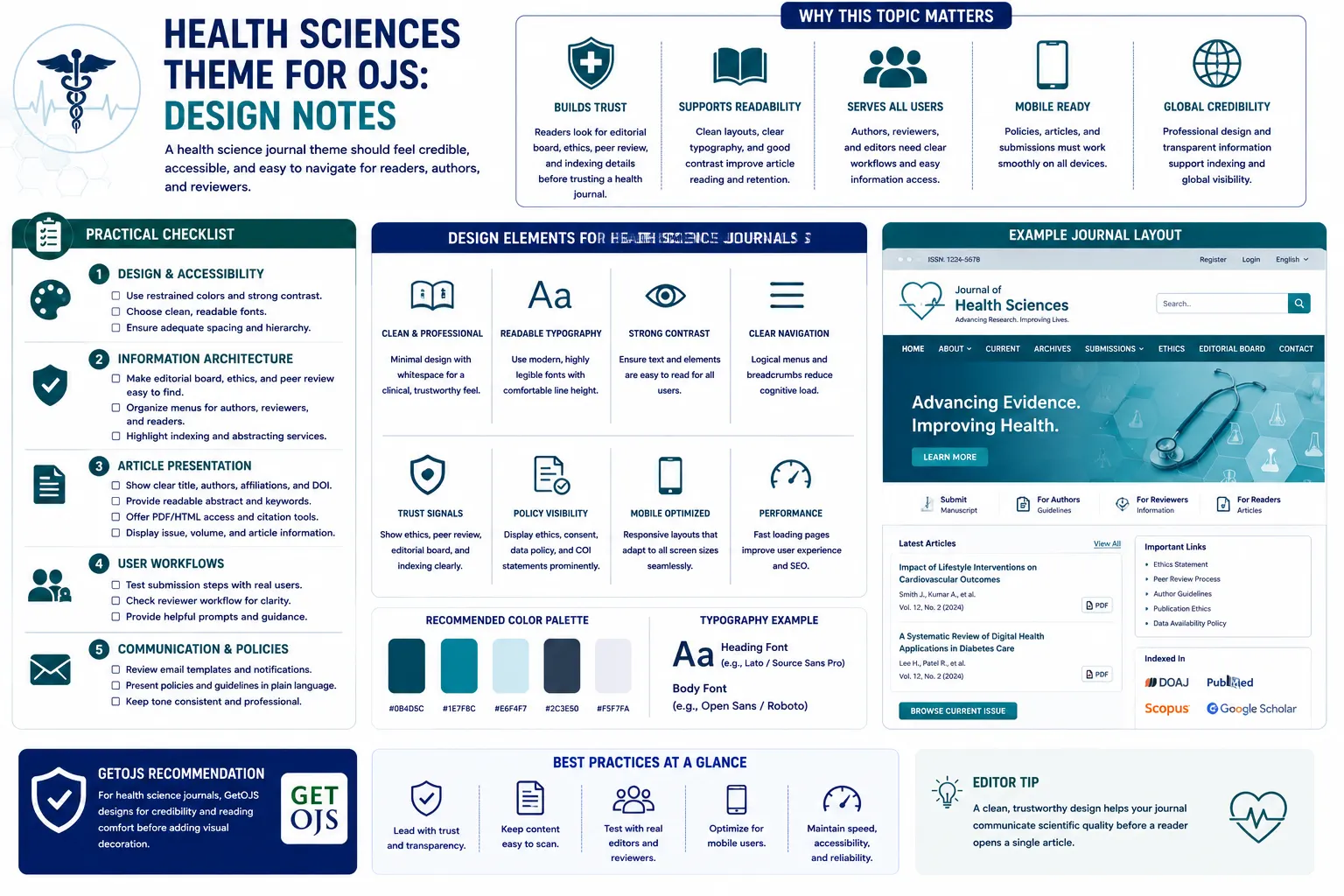
A medical or health sciences journal theme should feel credible, accessible, and easy to navigate for readers, authors, reviewers, editors, librarians, and institutional visitors. In health-related publishing, the design is not only about appearance; it also supports trust, transparency, ethical communication, and smooth access to scientific knowledge.
Introduction
Health sciences journals handle content that can influence clinical understanding, public health decisions, academic research, institutional reputation, and professional practice. Because of this, an OJS theme for a medical, nursing, pharmacy, biomedical, dental, allied health, public health, or life sciences journal must be designed with more care than a general magazine-style website. The layout should communicate seriousness, clarity, and reliability from the first screen. Visitors should immediately understand the journal title, subject area, publication model, submission route, editorial credibility, and access to current and archived issues.
A strong Health Sciences Theme for OJS should combine clean visual design with practical publishing requirements. Many authors visit a journal website to check whether the journal is legitimate before submitting a manuscript. Reviewers want quick access to their dashboard and assigned review tasks. Readers want abstracts, PDFs, references, metrics, and related articles without confusion. Editorial teams need pages that make policies, ethics, peer review, indexing claims, and author instructions easy to manage. Therefore, the theme should be built around usability, not decoration alone.
Why health sciences journals need a specialized OJS theme
Health science publishing depends heavily on trust signals. A journal website should not look random, outdated, or overly promotional. If the design is cluttered, slow, or difficult to read, visitors may doubt the journal quality even before reading the articles. A specialized OJS health sciences theme helps present the journal as organized, transparent, and academically responsible.
- Trust-focused presentation: Editorial board, peer review policy, publication ethics, plagiarism policy, archiving policy, and contact details should be visible and easy to verify.
- Readable article pages: Abstracts, keywords, author affiliations, DOI, citation formats, galley files, and references should be arranged with strong spacing and clear hierarchy.
- Mobile-friendly access: Authors and readers often open journal pages from mobile devices, so menus, tables, PDF buttons, and policy sections must work smoothly on small screens.
- Editorial transparency: Health journals must clearly show editorial processes, conflict of interest statements, informed consent guidelines, research ethics expectations, and corrections or retraction policies.
Visual direction and color system
The visual style should feel calm, professional, and scientific. Health sciences websites commonly work well with white backgrounds, soft blue, teal, green, navy, and light gray tones. These colors create a clean clinical impression without making the website look cold or empty. A health sciences OJS theme should avoid aggressive gradients, too many animations, low contrast text, and heavy decorative elements that distract from scholarly content.
The home page can use a clean hero area with the journal name, short scope statement, ISSN, publisher name, and clear buttons such as “Submit Manuscript,” “Current Issue,” and “About the Journal.” The theme should use large readable headings, comfortable paragraph spacing, and consistent card layouts. Article lists should show titles clearly, followed by author names, issue details, publication date, and access buttons. The aim is to help users scan information quickly while still giving the journal a polished identity.
Homepage structure for a health sciences journal
The homepage is the main trust-building page. It should not only show the latest issue but also explain what the journal publishes and why it is credible. A strong homepage structure may include a hero section, journal highlights, current issue block, about section, aims and scope, indexing or abstracting information, editorial policies, publication workflow, and quick links for authors and reviewers.
- Hero section: Display journal title, subject focus, ISSN, publisher, and main action buttons.
- Current issue: Show latest published articles with clean title spacing and easy PDF/HTML access.
- Journal highlights: Add cards for peer-reviewed, open access, DOI enabled, publication frequency, and editorial review process.
- Author support: Provide direct links to author guidelines, submission checklist, APC details, copyright policy, and template files.
- Ethics section: Highlight publication ethics, clinical trial policy, informed consent, data availability, and conflict of interest guidelines.
Article page design notes
The article detail page is one of the most important pages in OJS. For health sciences journals, this page should make research information clear and accessible. The article title should be prominent but not oversized. Author names and affiliations should be easy to read. DOI, publication date, issue details, section name, abstract, keywords, references, and PDF download should be arranged in a logical order.
PDF buttons should be visible but not overpowering. If the journal publishes HTML galleys, the theme should support clean reading with strong typography, accessible tables, figure captions, and reference formatting. Medical and health-related articles may include long abstracts, structured headings, tables, abbreviations, and supplementary material. The theme should handle this content without breaking the layout.
Sidebar information can include article metrics, citation tools, related articles, issue navigation, and sharing links. However, the sidebar should never reduce readability. On mobile, article metadata and buttons should stack properly. The reading flow should remain simple: title, authors, abstract, keywords, download/read options, and references.
Policy pages and ethical communication
Health sciences journals need detailed policy pages because authors and institutions often verify these details before submission. The OJS theme should make policy content readable through cards, headings, accordions, or structured blocks. Important policies include peer review process, publication ethics, plagiarism policy, conflict of interest, informed consent, human and animal research ethics, clinical trial registration, data availability, correction policy, retraction policy, copyright, licensing, archiving, and complaints policy.
Instead of placing all policies in one long unformatted page, the theme should use clear sections. Each policy page should have enough spacing, readable font size, and internal headings. Health-related policies should be written in direct language so authors can understand requirements before submission. A well-designed policy section reduces repeated support questions and improves the journal’s professional image.
Author guidelines and submission journey
The submission journey must be simple. Authors should not struggle to find the submit button or understand manuscript requirements. A health sciences theme should provide a strong “Submit Manuscript” button in the header or hero section. The author guidelines page should explain manuscript types, formatting rules, abstract structure, reference style, word limits, figure requirements, table formatting, ethical approval requirements, patient consent requirements, and declaration statements.
For health sciences journals, it is useful to add a submission checklist. This checklist can remind authors to include title page, author details, ORCID, ethics approval statement, conflict of interest declaration, funding statement, data availability statement, patient consent statement, references, figures, tables, and supplementary files. When these instructions are visible and organized, submissions become cleaner and editorial screening becomes faster.
Accessibility and readability
Accessibility is essential for academic publishing. A health sciences OJS theme should use strong color contrast, readable font sizes, proper heading order, alt text for images, keyboard-friendly navigation, and clear focus states. Buttons should look like buttons. Links should be easy to identify. Important information should not depend only on color.
Many users may access the journal from hospitals, universities, libraries, or low-bandwidth networks. Pages should load quickly and avoid unnecessary heavy scripts. Images should be optimized and lazy-loaded where possible. The theme should support readable tables on mobile devices because health articles often include statistical tables, demographic data, treatment comparisons, and laboratory values. A responsive table layout or horizontal scroll container can prevent broken page design.
Performance, SEO, and discoverability
Search visibility matters for journal growth. The theme should support clean titles, meta descriptions, canonical URLs, Open Graph tags, article schema where appropriate, XML sitemap support, and indexable article pages. OJS already provides many publishing features, but the theme must not hide important content behind scripts or broken layouts. Article titles, abstracts, keywords, author names, and DOI information should remain easy for search engines and indexing services to read.
Performance also affects user trust. A slow journal website can reduce submissions and increase bounce rate. The theme should use optimized CSS, compressed images, minimal JavaScript, browser caching, and clean HTML structure. Health sciences users usually come for information, not animation. Therefore, speed and clarity should be prioritized over unnecessary visual effects.
Recommended content blocks for the theme
A complete Health Sciences Theme for OJS can include reusable blocks for multiple pages. These blocks help the editorial team maintain a consistent design across the website. Common blocks include journal overview, aims and scope, editorial board, current issue, submission process, publication ethics, indexing information, article processing charges, reviewer guidelines, contact information, and frequently asked questions.
- Aims and scope cards: Useful for showing disciplines such as medicine, nursing, pharmacy, public health, dentistry, physiotherapy, biomedical science, and allied health.
- Editorial board layout: Should show names, roles, affiliations, country, and optional ORCID or profile links.
- Indexing section: Should display only verified indexing and abstracting services, avoiding misleading claims.
- APC section: Should clearly explain article processing charges, waiver policy, refund policy, and payment timing.
- FAQ block: Helpful for common author questions about review time, publication frequency, DOI, corrections, and submission status.
Security and maintenance considerations
Health sciences journals should also consider technical security. The OJS installation, plugins, and theme files should be kept updated. File upload settings should be reviewed carefully because journals receive many manuscript files, images, supplementary files, and revised documents. The website should use HTTPS, secure admin passwords, regular backups, spam protection, and controlled plugin usage.
A theme should not directly modify core OJS files unless absolutely necessary. The better approach is to create a proper child/custom theme or theme plugin structure, keep changes documented, and test updates on a staging copy before applying them to the live journal. This makes future OJS upgrades safer and reduces the risk of losing custom design work.
GetOJS recommendation
For health sciences journals, GetOJS recommends a design approach that puts credibility, reading comfort, policy transparency, and submission clarity before decoration. A good theme should help the journal look professional, but it should also support the real workflow of authors, reviewers, editors, and readers. The design should make important information easy to find, reduce confusion during submission, and present published research in a clean academic format.
If the journal is new, start with a simple and trustworthy design: strong homepage, clear aims and scope, complete author guidelines, visible editorial policies, and readable article pages. If the journal is already active, improve the design by studying user behavior, checking mobile issues, cleaning old policy pages, improving article metadata display, and optimizing speed. In both cases, the best Health Sciences OJS theme is the one that supports transparency, accessibility, and long-term journal growth.
Need help applying this to your journal?
Our team can help configure, migrate, secure, customize, or maintain your OJS journal website.