
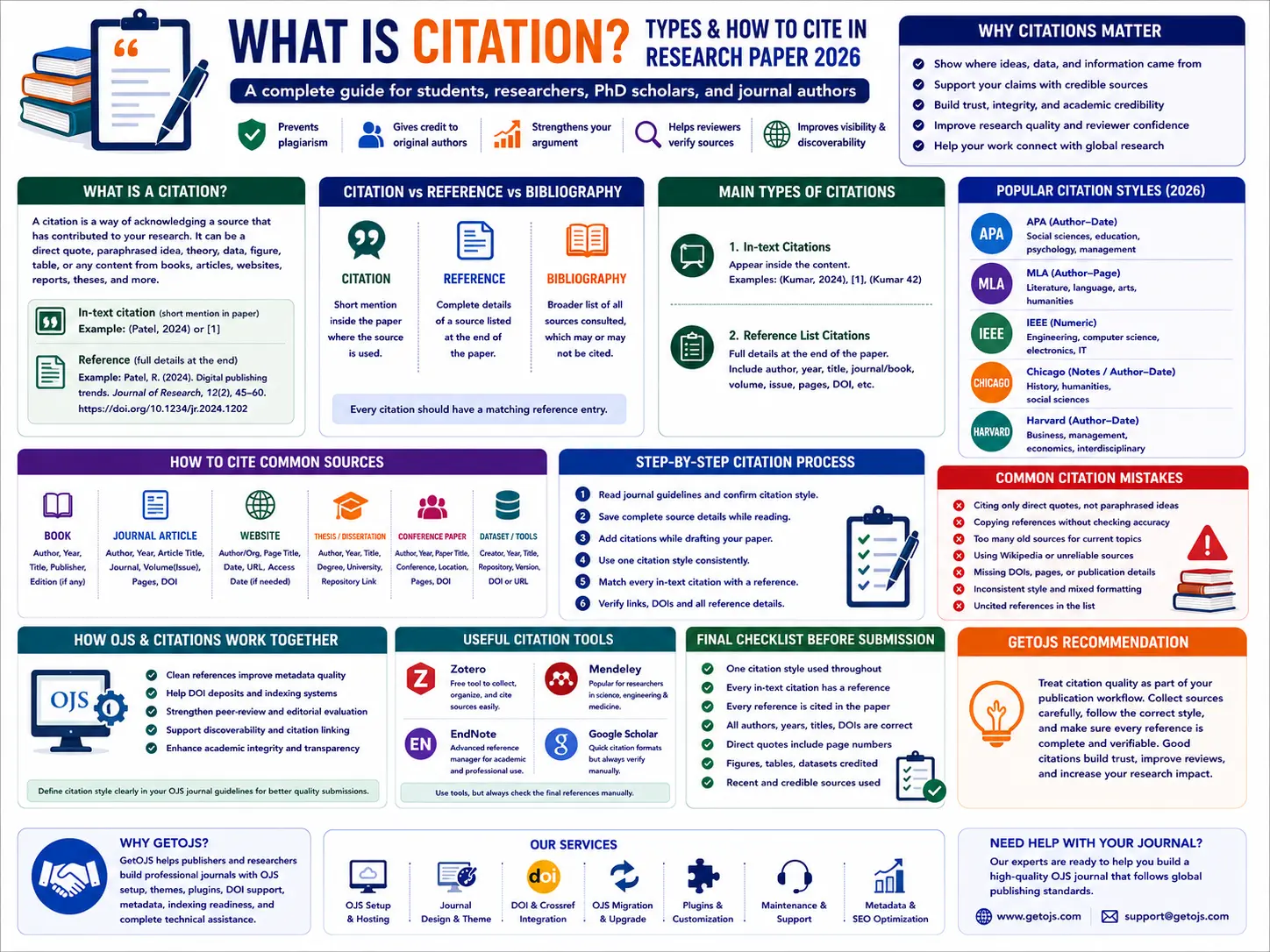
Citation is one of the most important parts of a research paper. It shows where your ideas, facts, quotations, data, methods, figures, and background information came from. For authors using OJS journals, correct citation practice also improves article quality, peer-review clarity, metadata accuracy, and long-term discoverability.
What is a citation?
A citation is a formal way of acknowledging a source that has contributed to your research paper. When you use another author’s idea, theory, result, definition, image, table, dataset, quotation, or even a paraphrased explanation, you should identify that source clearly. In simple words, a citation tells the reader that a specific point in your paper is supported by another published or traceable source.
A citation usually includes enough information for the reader to find the source again. Depending on the citation style, this may include the author name, publication year, article or book title, journal name, volume, issue, page range, publisher, DOI, URL, or access date. In the body of your paper, the citation may appear as an author-date format like (Patel, 2024), a numbered format like [1], or a footnote. At the end of the paper, the full source details appear in the references or bibliography section.
Citation, reference, and bibliography: what is the difference?
Many new researchers use the words citation, reference, and bibliography as if they mean the same thing. They are connected, but they are not exactly the same. A citation is the short source mention inside the paper. A reference is the complete source detail listed at the end of the paper. A bibliography is a broader list of sources consulted during research, including sources that may not be directly cited in the text, depending on the style guide or university requirement.
For example, if you write that digital publishing has changed journal visibility and add (Sharma, 2025) after the sentence, that is an in-text citation. The full entry for Sharma’s article in your reference list is the reference. If your department asks for all sources you read during the project, even those not cited directly, that larger list may be called a bibliography.
Why citations matter in research papers
- They prevent plagiarism: Proper citation makes it clear which ideas are yours and which ideas came from other scholars.
- They give credit: Research is built on previous work. Citations recognize the contribution of original authors.
- They strengthen your argument: A claim supported by reliable sources is more convincing than an unsupported statement.
- They help reviewers: Reviewers can verify whether your literature review, methods, and claims are grounded in credible research.
- They improve discoverability: Clean references, DOIs, and metadata help indexing systems and scholarly search engines connect related papers.
Main types of citations
Most research papers use two citation levels: in-text citations and end-of-paper references. Both are necessary. An in-text citation tells the reader which sentence or paragraph is connected to a source. The reference list gives the complete details of that source. If your paper has a citation in the text but no matching reference entry, the reader cannot trace the source. If your reference list includes a source that is never cited in the paper, the list may look careless or inflated.
1. In-text citations
In-text citations appear inside the main content of the paper. They may be placed at the end of a sentence or included naturally in the sentence. In APA and Harvard styles, you often see author and year formats, such as (Kumar, 2024). In MLA style, you may see author and page number, such as (Kumar 42). In IEEE and Vancouver styles, you may see numbers, such as [1] or [2].
2. Reference list citations
Reference list citations appear at the end of the article. They provide full details, such as author names, title, year, journal, volume, issue, pages, DOI, and publisher. A good reference list should be consistent, complete, and arranged according to the required style. In APA, MLA, Harvard, and Chicago author-date systems, entries are usually alphabetical. In IEEE, entries are numbered in the order in which they appear in the paper.
Popular citation styles in 2026
Different academic fields prefer different citation styles. Before formatting your paper, always check the target journal’s author guidelines. For OJS journals, the required style is usually mentioned on the Author Guidelines page, in the manuscript template, or in the submission checklist.
APA style
APA is common in education, psychology, management, social sciences, public health, and related fields. It uses the author-date system. Example in text: (Mehta, 2025). A journal article reference generally includes author, year, article title, journal title, volume, issue, pages, and DOI. APA is useful when the publication year is important because readers can quickly see how recent each source is.
MLA style
MLA is widely used in literature, language, arts, humanities, and cultural studies. It usually uses author-page citations. Example in text: (Desai 58). The end section is called Works Cited. MLA focuses strongly on authorship and textual location, which is helpful when discussing books, essays, poems, and literary passages.
IEEE style
IEEE is common in engineering, computer science, electronics, artificial intelligence, robotics, information technology, and related technical fields. It uses numbered citations. Example in text: [1]. The same number is used for the same source throughout the paper. This style keeps technical writing clean because long author-date citations do not interrupt equations, methods, or system descriptions.
Chicago style
Chicago has two common systems: notes and bibliography, and author-date. The notes system uses footnotes or endnotes and is common in history and some humanities subjects. The author-date version is closer to APA and Harvard. Chicago is flexible, but it must be applied carefully because punctuation, order, and note formatting matter.
Harvard style
Harvard is an author-date style used by many universities, business schools, and research institutions. Example in text: (Rao, 2024). It is easy for readers to follow and is often preferred in management, commerce, economics, and interdisciplinary research. Since Harvard has institutional variations, authors should follow the exact version required by their university or journal.
How to cite different source types
Books, journal articles, websites, conference papers, theses, reports, datasets, and AI tools all need slightly different information. A book citation normally needs author, year, title, publisher, and edition if applicable. A journal article needs author, year, article title, journal title, volume, issue, pages, and DOI. A website citation needs author or organization, page title, date, URL, and sometimes access date. A thesis needs author, year, title, degree type, university, and repository link if available.
When citing online sources, prefer stable and credible sources. Government portals, university websites, official reports, peer-reviewed journals, institutional repositories, and recognized organizations are stronger than random blogs or unverified pages. For scholarly work, DOI links are better than ordinary URLs because they are designed to remain stable even if the website changes.
Step-by-step citation process for research authors
- Step 1: Read the journal guidelines before writing. Confirm whether the journal wants APA, IEEE, MLA, Chicago, Harvard, Vancouver, or another style.
- Step 2: Save complete source details when you read. Do not wait until the final day to search for missing page numbers, DOIs, or publication years.
- Step 3: Add citations while drafting. Whenever you write a source-based sentence, add the citation immediately.
- Step 4: Use one citation style consistently. Mixing APA and IEEE in the same paper looks unprofessional and may lead to revision.
- Step 5: Match every in-text citation with a reference entry. This cross-check is one of the most important final editing steps.
- Step 6: Verify links and DOI records. Broken URLs and incomplete DOI details reduce trust in the reference list.
Useful citation tools for 2026
Citation managers can save a lot of time, especially for long papers and PhD work. Zotero is a strong free option for collecting references and inserting citations in Word or LibreOffice. Mendeley is popular with science and engineering researchers. EndNote is widely used in advanced academic environments. Google Scholar’s Cite button can be useful for quick formatting, but authors should not trust it blindly. Auto-generated citations may miss capitalization, page ranges, journal issue numbers, or DOI formatting.
The best approach is to use a citation manager but still manually check important references before submission. A journal editor or reviewer may not reject a paper only because of one small punctuation issue, but repeated formatting mistakes, missing references, and broken citation links create a negative impression.
Common citation mistakes to avoid
Many student papers lose quality because of avoidable citation errors. The most common mistake is citing only direct quotations and forgetting to cite paraphrased ideas. Even if you rewrite another author’s idea in your own words, you still need to cite it. Another common mistake is copying references from websites without checking accuracy. Some sources show author names incorrectly or omit DOI information.
Authors should also avoid using too many old sources for current topics. Older sources can be valuable for theory and history, but a 2026 research paper should usually include recent studies where the topic is fast-moving, such as artificial intelligence, digital health, climate technology, cybersecurity, or education technology. Avoid citing Wikipedia as a main academic source. It can help you understand a topic, but research papers should rely on original, authoritative, and peer-reviewed sources whenever possible.
Citations and OJS journal publishing
For journals using Open Journal Systems, citations are not only part of the manuscript text. They also affect metadata quality, DOI deposits, indexing readiness, and article visibility. Clean references help readers move from one research work to another. They also support services that analyze scholarly links between articles. If references are incomplete or inconsistent, the article may still be published, but it becomes harder for databases and readers to understand the paper’s academic connections.
Journal managers should make citation expectations clear in the Author Guidelines page. They can mention the preferred style, minimum reference quality, DOI requirements, self-citation policy, and formatting examples. Editors can also add citation checks to the review or copyediting stage so that problems are fixed before final publication.
Final checklist before submission
- The same citation style is used from start to finish.
- Every in-text citation has a matching reference entry.
- Every reference entry is cited somewhere in the paper.
- Author names, years, titles, volume numbers, issue numbers, pages, and DOIs are checked.
- Direct quotations include page numbers where required by the style.
- Figures, tables, datasets, tools, and adapted content are properly credited.
- Recent and credible sources are included, especially for current research topics.
GetOJS recommendation
GetOJS recommends treating citation quality as part of the publication workflow, not as a last-minute formatting task. Authors should collect sources carefully while writing, editors should define a preferred citation style clearly, and journal teams should check references before publication. A well-cited paper looks more professional, supports ethical publishing, and gives readers a reliable path to verify and explore the research.
Need help improving your OJS journal workflow?
Our team can help configure author guidelines, submission checklists, editorial workflows, metadata settings, DOI support, themes, plugins, migration, and OJS maintenance.