
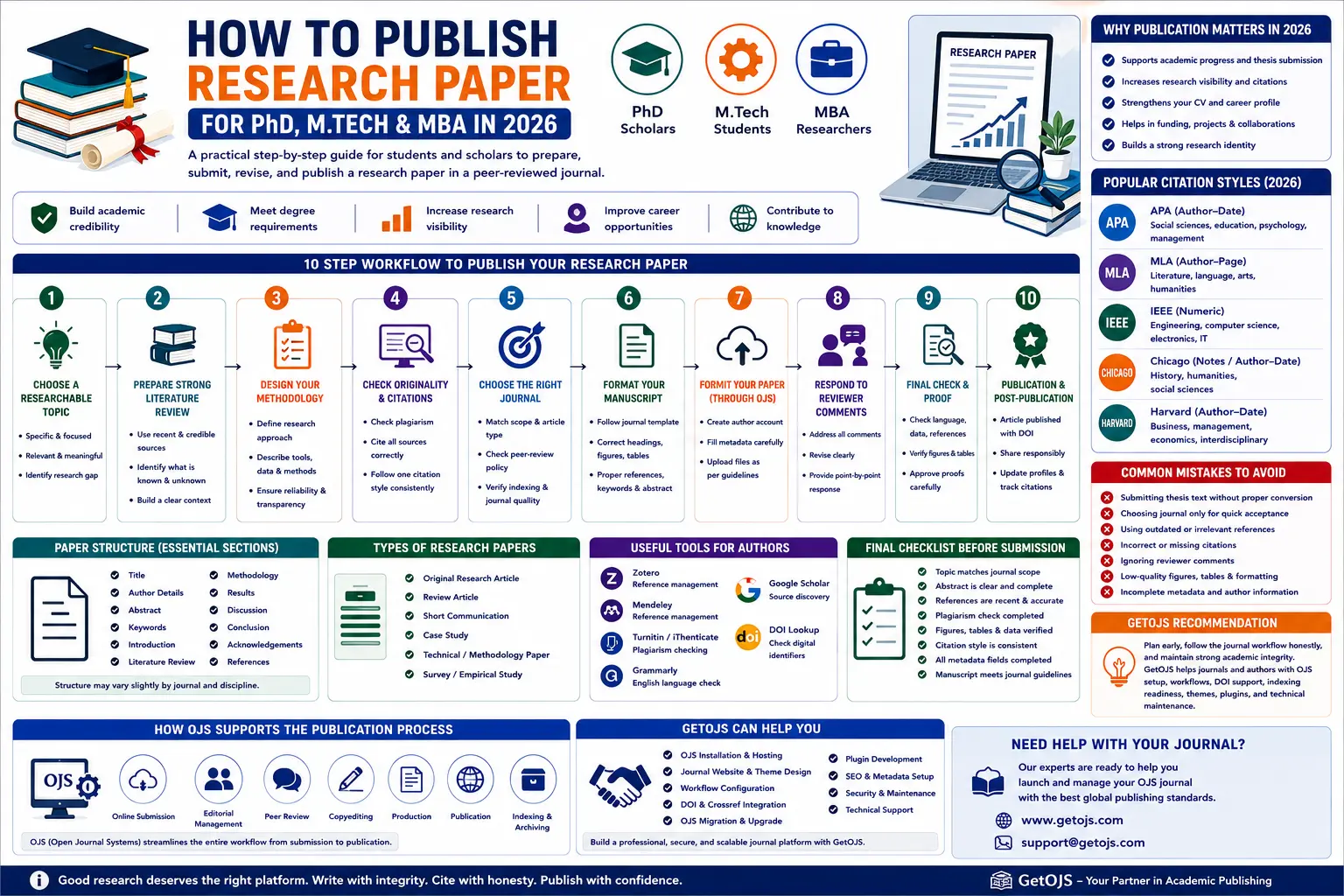
Publishing a research paper in 2026 is no longer only about writing a good manuscript. Students and scholars also need to understand journal selection, formatting, plagiarism control, peer review, indexing expectations, metadata, copyright, and post-publication visibility.
Why research paper publication matters in 2026
For PhD scholars, M.Tech students, MBA researchers, and first-time authors, a published paper can support academic progress, thesis submission, project evaluation, career applications, and research visibility. However, publication should never be treated as a shortcut or a last-minute formality. A strong paper must present a clear problem, a relevant literature base, a suitable method, reliable findings, and properly cited sources.
Many students begin with the question, “Where can I publish fast?” A better question is, “Is my paper ready for peer review?” Speed is useful only when quality is not compromised. A journal may publish monthly or continuously, but the author’s responsibility remains the same: submit original work, follow journal guidelines, respond professionally to reviewer comments, and keep the research record clean.
- PhD scholars usually need stronger originality, deeper literature review, and a clear research contribution.
- M.Tech students often convert thesis experiments, simulations, prototypes, or technical models into journal papers.
- MBA students normally prepare empirical, analytical, case-based, or industry-focused studies using management frameworks.
Understand what type of paper you are writing
Before choosing a journal, identify your manuscript type. A PhD paper may be an original research article, review article, theoretical paper, methodology paper, or part of a thesis chapter. An M.Tech paper may come from software development, experimental testing, machine learning implementation, civil engineering analysis, electrical simulation, mechanical design, or data-driven comparison. An MBA paper may use surveys, interviews, financial analysis, marketing analytics, HR data, operations research, or business case evaluation.
This step matters because journal scope is not only about subject area. It also includes article type, research depth, methodology expectations, formatting style, and review standards. A strong paper submitted to the wrong journal can still be rejected. Read the “Aims and Scope” page carefully and check whether the journal has previously published similar topics.
Step 1: Choose a focused and researchable topic
A good topic is specific enough to study and broad enough to matter. Instead of selecting “Artificial Intelligence in Business,” a better topic could be “Adoption of generative AI tools among digital marketing teams in Indian startups.” Instead of “Solar Energy,” a stronger M.Tech topic may be “Performance comparison of MPPT algorithms for solar photovoltaic systems under partial shading conditions.”
Use recent research papers to identify a research gap. A research gap may be a missing population, outdated dataset, limited method, unexplored region, weak comparison, or unresolved practical problem. For PhD and postgraduate work, the topic should connect to a clear objective. For MBA work, it should also show managerial relevance. For engineering work, it should ideally include technical validation, experiment, simulation, comparison, or measurable outcome.
Step 2: Prepare a standard research paper structure
Most journals expect a clean academic structure. The exact format may differ, but a typical manuscript includes title, author details, abstract, keywords, introduction, literature review, methodology, results, discussion, conclusion, acknowledgements, funding statement, conflict of interest statement, and references.
- Title: Keep it clear, specific, and searchable. Avoid overly long or promotional titles.
- Abstract: Summarize the problem, method, key results, and contribution in simple academic language.
- Keywords: Add 4 to 6 terms that match the topic and help indexing systems understand the article.
- References: Use the style required by the journal, such as APA, IEEE, Harvard, Vancouver, or Chicago.
Step 3: Build a strong literature review
The literature review should not be a collection of random summaries. It should explain what has already been studied, what methods were used, what limitations remain, and how your paper adds value. Reviewers often judge the seriousness of a paper by its literature review. If the references are old, unrelated, or poorly cited, the paper may look weak even when the idea is good.
Use peer-reviewed journal articles, conference papers, books, standards, reports, and credible institutional sources. Avoid relying heavily on blogs, Wikipedia pages, or generic websites. Recent sources are important, especially in fast-moving fields like artificial intelligence, cybersecurity, healthcare technology, fintech, digital marketing, renewable energy, and data science.
Step 4: Explain your methodology clearly
The methodology section tells reviewers how the research was conducted. For technical papers, it may include dataset details, tools, algorithms, equations, simulation settings, experimental setup, hardware configuration, or evaluation metrics. For MBA papers, it may include research design, sampling method, questionnaire design, data collection approach, statistical test, and analysis software. For PhD papers, it may require deeper justification of the research design and limitations.
Do not hide weak methodology behind complicated language. Explain your process clearly so another researcher can understand what you did. If the paper uses survey data, mention sample size and sampling method. If it uses secondary data, mention source and date range. If it uses software, mention version or configuration where relevant. If it uses AI tools for language assistance, check the journal’s policy and disclose usage where required.
Step 5: Check plagiarism, originality, and citation quality
Plagiarism is one of the most common reasons for rejection. Similarity may come from copied paragraphs, reused thesis text, uncited paraphrasing, copied tables, repeated methodology, or references taken without reading. Always rewrite in your own words, cite the original source, and use quotation marks for direct quotes when the citation style allows it.
Many universities and journals use tools such as Turnitin, DrillBit, iThenticate, or other similarity checkers. A low similarity percentage is helpful, but it does not automatically prove originality. Reviewers also check whether the idea, data, and interpretation are genuinely your own. Self-plagiarism is also a risk if you reuse your previous thesis, conference paper, or project report without proper disclosure.
Step 6: Select the right peer-reviewed journal
Choosing the right journal is one of the most important decisions in publication. Do not select a journal only because it promises quick acceptance. Check the journal website, editorial board, peer-review policy, publication ethics, author guidelines, ISSN, contact details, indexing claims, archive, article quality, and publication frequency. A professional journal website should clearly explain how submissions are reviewed and what authors should expect after submission.
For journals using Open Journal Systems, authors usually submit through an online workflow. OJS helps manage author registration, manuscript upload, editorial assignment, peer review, revision files, copyediting, production, issue scheduling, article metadata, and galley files such as PDF or HTML. GetOJS supports journals by helping them configure these workflows properly, so editorial teams can handle submissions in an organized way.
Step 7: Format the manuscript according to the journal template
Formatting may look simple, but it affects first impression. Before submission, check title style, author affiliation format, heading levels, figure captions, table captions, citation style, reference format, word limit, file type, image resolution, and supplementary file rules. If the journal provides a template, use it from the beginning instead of adjusting everything at the end.
For engineering and computer science papers, IEEE-style references are common. For management, education, psychology, and social science topics, APA or Harvard may be used. Some medical and health journals use Vancouver style. The best rule is simple: never mix citation styles in the same manuscript.
Step 8: Submit through the journal system
When your paper is ready, create an author account and complete the submission steps carefully. Add the title, abstract, keywords, contributors, references, funding details, conflict-of-interest statements, and manuscript file exactly as requested. In OJS, incomplete metadata can reduce discoverability after publication, so do not treat metadata fields as optional when they are important for indexing.
After submission, save the confirmation email and paper ID. Do not submit the same paper to multiple journals at the same time. Simultaneous submission is considered unethical by most peer-reviewed journals.
Step 9: Respond to reviewer comments professionally
Peer review may result in acceptance, minor revision, major revision, resubmission, or rejection. Revisions are normal and should not be taken personally. Create a response document that lists each reviewer comment and explains how you addressed it. If you disagree with a suggestion, respond politely with academic reasoning.
Revised manuscripts should be carefully checked before resubmission. Highlight changes if requested. Update figures, references, tables, and conclusions if the revision affects them. Many papers improve significantly during the review process, so treat reviewer comments as part of the quality-building stage.
Step 10: Final production and publication
After acceptance, the manuscript may move to copyediting and production. This stage may include language correction, layout preparation, PDF proofing, metadata verification, DOI assignment where available, issue placement, and final publication. Authors should check proofs carefully because errors in names, affiliations, tables, and references can remain permanently visible after publication.
Once published, share the article responsibly. Add it to your CV, institutional profile, ORCID record, Google Scholar profile, ResearchGate profile, or personal academic page. Make sure the citation details are correct and use the official article URL when sharing.
Common mistakes students should avoid
- Submitting a thesis chapter without converting it into a proper journal article.
- Choosing a journal without checking scope, review policy, or editorial details.
- Using outdated references for a current research topic.
- Copying citations from Google Scholar without verifying accuracy.
- Ignoring reviewer comments or replying emotionally instead of academically.
- Uploading low-quality figures, incomplete metadata, or wrong author affiliations.
GetOJS recommendation
For authors, the best publication strategy is to prepare early, choose carefully, and follow the journal workflow honestly. For journal teams, the best strategy is to provide clear author guidelines, a transparent peer-review process, clean OJS configuration, and reliable communication. When both sides follow a structured process, publication becomes smoother, more credible, and easier to track.
GetOJS helps journals set up professional OJS websites, configure submission workflows, design author-friendly pages, manage metadata quality, support DOI and indexing readiness, and maintain secure journal platforms. A strong journal platform does not replace peer review, but it supports every step from submission to final publication.
Final checklist before submitting your paper
- The topic is specific and aligned with the journal scope.
- The abstract clearly explains problem, method, result, and contribution.
- References are recent, credible, and formatted in one consistent style.
- Plagiarism and self-plagiarism have been checked carefully.
- Figures, tables, author details, affiliations, and keywords are complete.
- The manuscript follows the journal template and submission instructions.
Need help creating a professional journal website?
GetOJS can help configure, customize, migrate, secure, and maintain your OJS journal platform for smooth peer-reviewed publishing.