
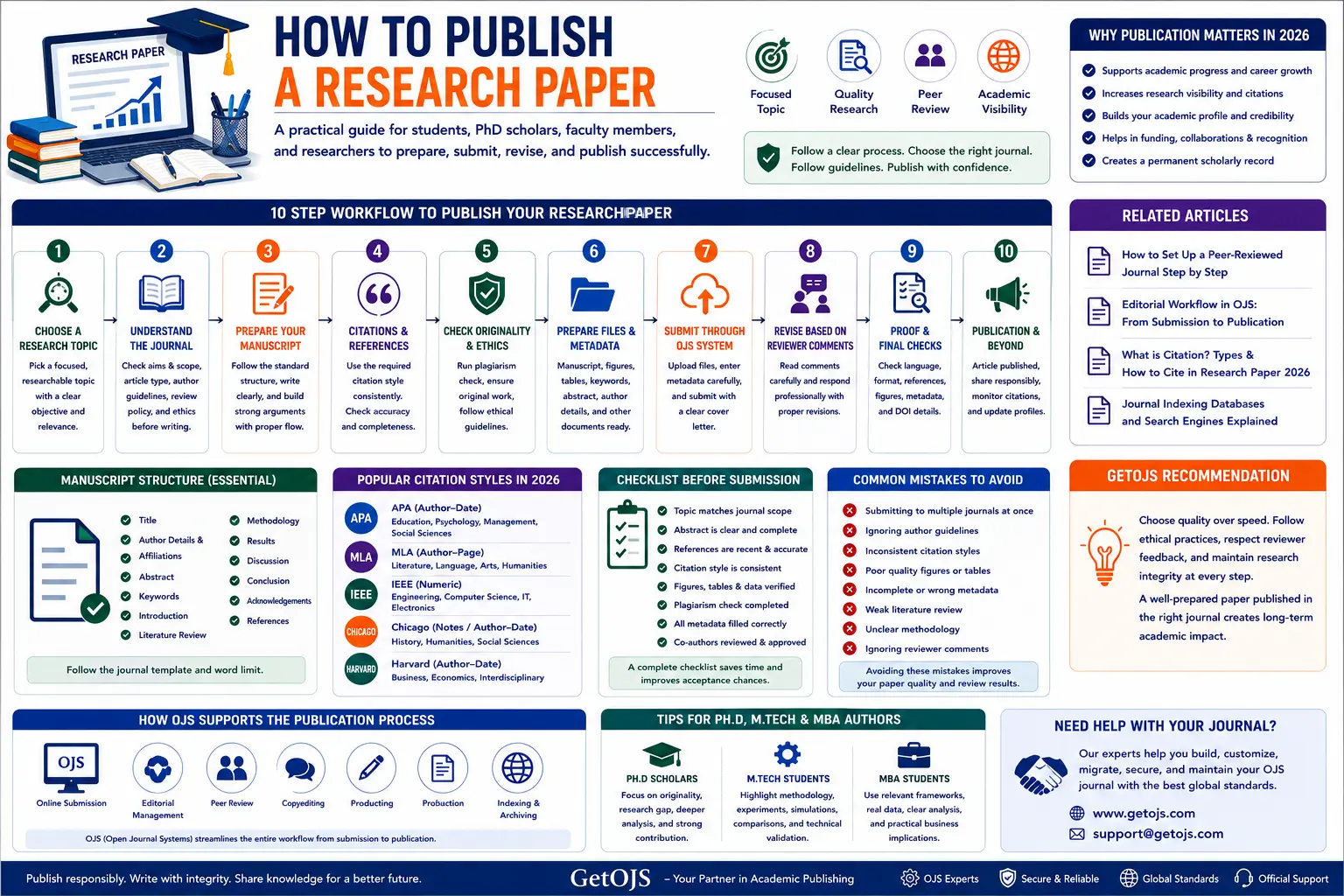
Publishing a research paper is one of the most important academic milestones for students, PhD scholars, faculty members, and early-career researchers. In 2026, the process is more digital, more transparent, and more dependent on clean metadata than ever before.
Why research publication matters in 2026
A published research paper is not only a document on a journal website. It is a public academic record that shows your topic, methods, findings, authorship, affiliation, references, and contribution to a field. For students, it can support thesis submission, viva preparation, project evaluation, and higher-study applications. For faculty members and professional researchers, publication supports academic visibility, institutional reporting, funding applications, collaboration, and long-term citation growth.
However, publishing successfully is not only about submitting a Word file to a journal. A strong paper needs a focused research question, a clear literature review, a suitable methodology, properly formatted references, ethical writing, and a journal that matches the subject. Many authors face rejection because they rush the process. They choose a journal without checking scope, ignore author guidelines, submit with incomplete metadata, or use inconsistent citation styles. A careful process saves time and protects the credibility of the author and the journal.
Step 1: Choose a focused and publishable research topic
The first step is to narrow your topic. A broad topic may look attractive, but it is difficult to publish because it usually lacks a clear argument. For example, “Artificial Intelligence in Education” is too wide. A stronger topic would be “Use of AI-based feedback tools to improve writing performance among undergraduate students.” The second version tells readers what technology is being studied, where it is applied, and what outcome is being measured.
A publishable topic should answer three questions: What problem are you solving? Why does the problem matter now? What is new or useful about your work? Before writing, check recent papers in your subject area and identify gaps. Look for limitations in earlier studies, new data sources, regional gaps, under-tested methods, or practical problems that need better explanation. This will help you position your paper as a contribution rather than a general essay.
Step 2: Understand your target journal before writing
One common mistake is writing the full paper first and searching for a journal later. A better method is to shortlist possible journals early. Read their aims and scope, accepted article types, word limit, reference style, publication ethics, peer-review policy, APC or fee policy, and submission checklist. If the journal uses Open Journal Systems, check the submission steps and required metadata fields so you can prepare everything before creating your submission.
Credible journals usually display the editorial board, contact information, author guidelines, review policy, publication ethics, archive, issue structure, and indexing information clearly. Be careful with journals that promise guaranteed acceptance, unrealistic review times, fake impact factors, missing ISSN details, hidden charges, or unclear editorial ownership. A journal should be selected for fit and credibility, not only for speed.
Step 3: Prepare a complete manuscript structure
Most research papers follow a standard structure, although the exact format depends on the discipline and journal template. A typical paper includes the title, author names, affiliations, abstract, keywords, introduction, literature review, methodology, results, discussion, conclusion, acknowledgements, funding information, conflict-of-interest statement, and references. Some journals also require data availability statements, ethics approval details, author contribution statements, or supplementary files.
The title should be specific and searchable. The abstract should summarize the problem, purpose, method, key findings, and conclusion in a compact way. Keywords should match the terms that readers and databases may use to find your paper. The introduction should explain the background and research gap. The literature review should not be a random list of previous studies; it should show how existing research leads to your study. The methodology must be clear enough for another researcher to understand how the study was conducted. The results should present findings honestly, and the discussion should explain what those findings mean.
Step 4: Format references and citations correctly
References are a major part of research quality. Inconsistent citations make a paper look careless, even if the research itself is useful. Always follow the journal’s required citation style. Engineering and computer science journals often use IEEE. Social sciences, education, management, psychology, and health-related fields may use APA. Humanities may use MLA or Chicago. Business and some international universities may prefer Harvard style.
Use reference management tools such as Zotero, Mendeley, EndNote, or a verified citation generator, but never trust generated citations blindly. Check author names, year, article title, journal title, volume, issue, page range, DOI, and URL. Every in-text citation should have a matching reference entry, and every reference entry should be cited in the paper. Do not cite sources you have not read. Avoid depending heavily on blogs, Wikipedia pages, or non-academic websites unless your topic specifically requires them.
Step 5: Check originality and research ethics
Originality is not only about low plagiarism percentage. It also means the work is honest, properly attributed, and not duplicated from your previous submission. Before submitting, check the manuscript for copied text, missing citations, reused figures, duplicated tables, or AI-generated content that has not been reviewed properly by the author. If you use AI tools for language polishing, brainstorming, or grammar support, check the journal’s policy on AI disclosure.
For studies involving human participants, surveys, interviews, patient records, or sensitive data, include appropriate consent and ethics information where required. Do not fabricate data, modify results to fit expectations, or hide negative findings. A transparent paper with modest but reliable results is better than an exaggerated paper that cannot survive peer review.
Step 6: Prepare files for online journal submission
Most modern journals collect submissions through an online platform such as OJS. Before uploading, prepare the manuscript file, title, abstract, keywords, author details, ORCID IDs, affiliations, cover letter, declarations, figures, tables, supplementary files, and references. Make sure the manuscript file follows the journal template and that figures are readable. If the journal requires anonymized peer review, remove author names and identifying details from the manuscript file before submission.
When entering metadata in OJS, do not copy incomplete information. Article metadata is used for indexing, search, DOI registration, citation exports, and journal archives. A typo in the title, author name, affiliation, DOI, or abstract can continue to appear in external systems after publication. Treat metadata entry as a production task, not a formality.
Step 7: Submit with a clear cover letter
A cover letter should be short and professional. Mention the title of the manuscript, article type, originality of the submission, fit with the journal scope, and confirmation that the paper is not under review elsewhere. Do not oversell the paper with dramatic claims. Editors appreciate clarity, honesty, and relevance. If the study has ethical approval, funding, or special context, mention it briefly.
After submission, save the submission ID and confirmation email. If the journal uses OJS, you can usually track the paper through the dashboard. Avoid sending repeated follow-up emails immediately after submission. Give the editorial team time to complete initial checks and reviewer assignment.
Step 8: Respond to reviewer comments professionally
Peer review is not a personal attack. It is part of the quality-control process. If you receive revision comments, read them carefully and prepare a response document. Reply point by point. For each comment, explain what you changed and where the change appears in the revised manuscript. If you disagree with a comment, respond politely and provide a clear academic reason.
Common revision requests include improving the literature review, clarifying methodology, adding recent references, correcting citation style, improving language, expanding discussion, restructuring tables, or explaining limitations. Do not ignore reviewer comments. A weak response can lead to rejection even when the manuscript has potential.
Step 9: Complete copyediting, proofreading, and publication checks
Acceptance is not the final step. After acceptance, the paper may move into copyediting and production. At this stage, check spelling, grammar, layout, author names, affiliations, ORCID IDs, DOI, references, figure captions, table titles, page numbers, issue details, and PDF galley. If the journal publishes HTML, XML, or other full-text formats, compare those versions with the final manuscript to ensure no content has been lost.
Many errors happen during the final stage because authors stop paying attention after acceptance. Carefully review proofs before approval. Once published, some corrections may require formal notices or version updates, so it is better to fix mistakes before the paper goes live.
What different authors should focus on
PhD scholars should focus on strong research gaps, original contribution, updated literature, ethical compliance, and journal credibility. A PhD paper should support the larger thesis argument, not simply repeat a chapter without adaptation.
M.Tech and engineering students should focus on methodology, experiments, simulations, performance comparison, reproducibility, and IEEE-style references when required. A project report must be converted into a research paper format before submission.
MBA and management students should focus on problem context, survey design, data quality, industry relevance, statistical analysis, and practical implications. The paper should connect business theory with real decision-making value.
Faculty and early-career researchers should focus on journal fit, long-term citation value, collaboration, ORCID profile consistency, and institutional publication requirements.
Common mistakes to avoid
- Submitting the same manuscript to multiple journals at the same time.
- Choosing a journal only because it is fast or cheap.
- Ignoring author guidelines and manuscript templates.
- Using inconsistent citation styles inside the same paper.
- Uploading low-quality figures or incomplete supplementary files.
- Forgetting to check author names, affiliations, and metadata before publication.
Final checklist before submission
- The topic is focused and aligned with the journal scope.
- The manuscript follows the journal template and word limit.
- Abstract, keywords, tables, figures, and references are complete.
- All citations and references match correctly.
- Plagiarism and originality checks have been completed.
- All authors have approved the final version before submission.
GetOJS recommendation
For journals using Open Journal Systems, publication quality depends on both editorial discipline and technical setup. GetOJS recommends building a clean submission workflow, clear author guidelines, tested email templates, reliable metadata entry, and properly configured publication pages before inviting large numbers of authors to submit. A well-managed OJS journal helps authors submit correctly, helps editors review efficiently, and helps published papers become easier to discover through search engines, indexing services, and citation tools.
Need help setting up a journal submission workflow?
GetOJS can help configure, migrate, customize, secure, and maintain your OJS journal website with proper editorial and publishing workflows.