
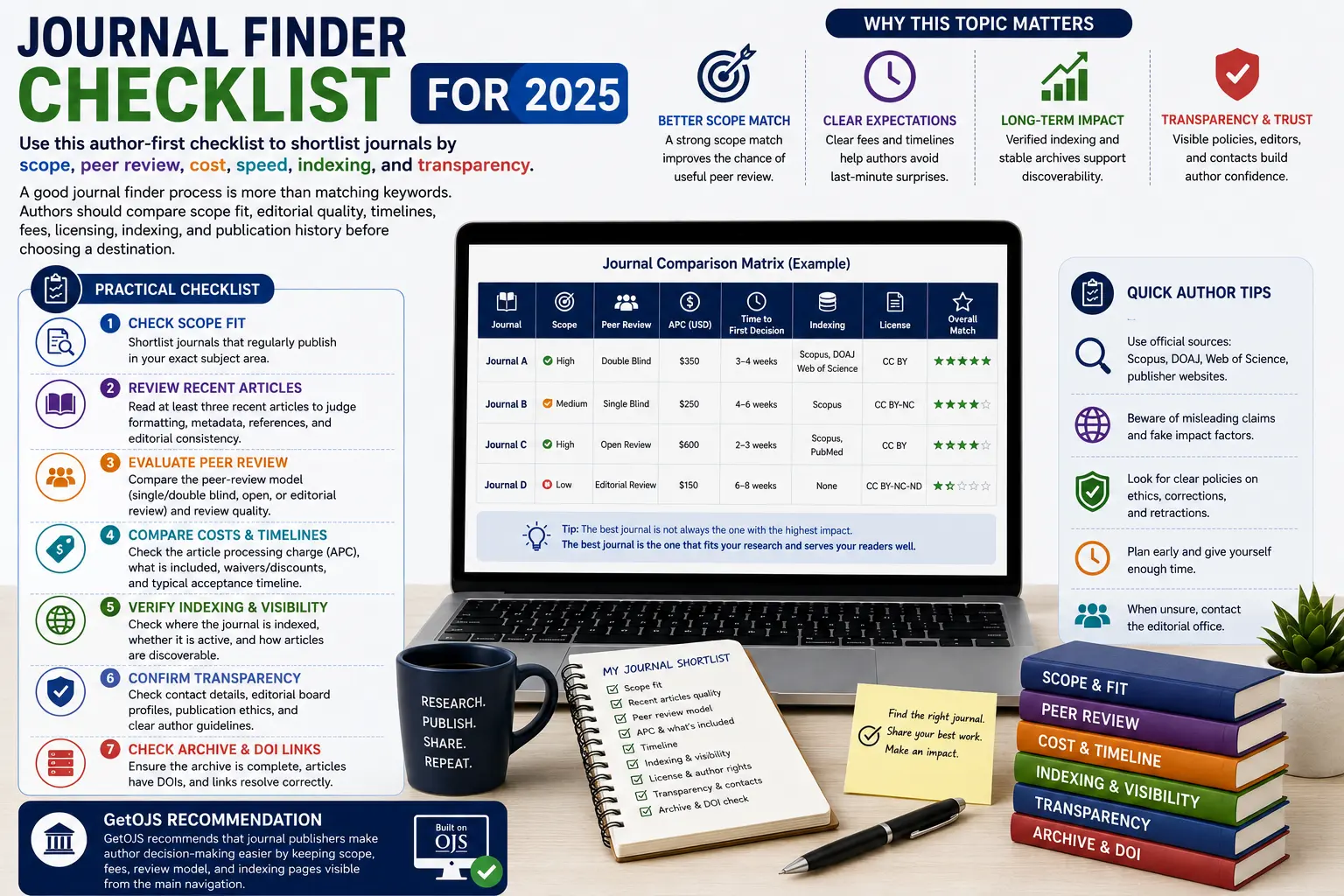
Choosing the right journal is one of the most important decisions in the research publication journey. A good journal finder process is not only about searching keywords or selecting the fastest option. Authors should compare scope fit, peer review quality, publication fees, indexing claims, editorial transparency, article visibility, archive stability, and ethical publishing practices before submitting a manuscript.
Journal Finder Checklist for 2025: Why It Matters
In 2025, authors have more publishing options than ever before. There are traditional subscription journals, open access journals, hybrid journals, university journals, society journals, multidisciplinary journals, and conference proceedings. This wide choice is helpful, but it can also create confusion for early-career researchers, Ph.D. scholars, faculty members, and independent authors who want to publish safely and professionally.
A journal may look attractive because it promises quick publication, low article processing charges, or indexing in popular databases. However, authors should never rely only on promotional claims. The best approach is to build a shortlist, verify each journal carefully, and choose the one that matches the manuscript's subject, quality level, publication goals, and institutional requirements.
1. Start with Scope Match
The first step in any journal finder checklist is checking whether your manuscript fits the journal's aims and scope. Even a strong paper can be rejected if it does not match the journal's subject focus. Read the journal's scope page carefully and compare it with your title, abstract, methodology, keywords, and references.
- Check whether the journal regularly publishes articles in your exact research area.
- Read recent articles to understand the journal's preferred topics and writing style.
- Avoid journals where your paper only loosely fits the subject category.
For example, a paper on artificial intelligence in healthcare may fit computer science, medical informatics, biomedical engineering, or public health journals depending on the main contribution. The right journal depends on whether your paper is primarily technical, clinical, policy-based, or application-focused.
2. Check the Journal's Recent Publications
Before submitting, review at least three to five recent articles from the journal. This simple step helps you judge editorial consistency, formatting quality, reference style, metadata accuracy, article layout, and publication frequency. A well-managed journal usually has complete article pages, clear author details, DOI links where applicable, structured abstracts, keywords, references, and downloadable files.
If recent issues are missing, article pages are incomplete, PDFs look unprofessional, or metadata is inconsistent, treat it as a warning sign. Strong publication presentation supports long-term discoverability in Google Scholar, indexing databases, institutional repositories, and academic search engines.
3. Understand the Peer Review Model
Peer review is one of the strongest indicators of journal quality. A reliable journal should clearly explain whether it follows single-anonymous review, double-anonymous review, open peer review, editorial review, or another review model. The policy should mention how reviewers are selected, how conflicts of interest are handled, and how editorial decisions are made.
- Look for a clear peer-review policy on the journal website.
- Check whether review timelines are realistic and not misleading.
- Confirm whether revisions are required before acceptance.
- Avoid journals that guarantee acceptance without proper review.
Fast review is not automatically bad, but unrealistic promises such as acceptance within one or two days can indicate weak editorial screening. Good journals balance efficiency with quality control.
4. Verify Indexing Claims Carefully
Many authors choose journals based on indexing requirements. Indexing can improve visibility, but claims must be verified. A journal website may mention Scopus, Web of Science, DOAJ, UGC, Crossref, Google Scholar, PubMed, Index Copernicus, or other platforms. Authors should check official records wherever possible instead of relying only on logos placed on the journal website.
When verifying indexing, compare the exact journal title, ISSN, publisher name, website URL, coverage years, subject category, and active or discontinued status. Some journals may have similar names, old indexing claims, changed publishers, discontinued coverage, or clone websites. A careful verification process protects authors from submitting to the wrong journal.
5. Compare Article Processing Charges and Publication Fees
Cost is a major factor for many authors, especially in India and other regions where researchers may not always receive publication funding. A transparent journal should publish its article processing charge, payment schedule, refund policy, waiver policy, and what the fee includes. Fees should not be hidden until after acceptance.
Affordable does not mean low quality, and expensive does not always mean high quality. The key is transparency. A reasonable fee may cover editorial management, website maintenance, DOI registration, copyediting, typesetting, XML preparation, archiving, hosting, and technical support. Authors should evaluate value, not just price.
6. Review Publication Timeline Realistically
Authors often need publication within a specific academic timeline, such as thesis submission, promotion, funding reporting, or project completion. A journal finder process should include review speed, revision time, acceptance timeline, production timeline, and issue publication schedule.
Check whether the journal publishes continuously, monthly, quarterly, biannually, or annually. If the journal has not published recent issues on time, the stated timeline may not be reliable. It is better to choose a journal with a realistic schedule than one that promises speed without evidence.
7. Check Editorial Board and Contact Details
A credible journal should clearly display its editorial board, editor-in-chief, section editors, institutional affiliations, and contact details. The editorial board should match the journal's subject area. If the journal covers engineering, medicine, management, education, and social sciences, the board should include experts across those fields.
Also check whether the journal provides a professional email address, office address, publisher information, and support contact. Poor contact transparency can create problems if you need help during submission, revision, payment, or publication correction.
8. Review Author Guidelines
Strong author guidelines make submission easier and reduce editorial delays. The journal should explain article types, manuscript structure, formatting requirements, reference style, figure requirements, plagiarism policy, ethics approval, conflict of interest declaration, funding statement, copyright terms, and licensing policy.
- Check manuscript template and formatting instructions.
- Confirm word limit, abstract structure, and keyword requirements.
- Review plagiarism, ethics, copyright, and correction policies.
- Prepare all required files before starting submission.
9. Check DOI, Archive, and Long-Term Visibility
A good journal should provide stable article pages and long-term access to published content. DOI registration is useful because it gives articles a persistent identifier and supports citation linking. However, DOI alone is not a complete quality guarantee. Authors should also check whether DOI links resolve correctly and whether older articles remain accessible.
Archive quality is equally important. Past issues should be organized by volume, issue, year, and article title. Each article should include title, author names, abstract, keywords, PDF, citation details, DOI if available, and publication date. Clean archives improve author confidence and support SEO for journal websites.
10. Identify Warning Signs Before Submission
Not every journal that appears online is suitable for publication. Authors should look for warning signs before submitting a manuscript or paying any fee.
- Guaranteed acceptance without peer review.
- Unclear publication charges or hidden fees.
- Fake indexing logos without official verification.
- Missing editorial board or unverifiable editor details.
- Broken links, incomplete archives, and copied content.
- Very broad scope with no qualified section editors.
11. Build a Journal Shortlist
Instead of choosing the first journal you find, create a shortlist of three to five suitable journals. Compare them using the same criteria: scope fit, recent publications, peer review policy, indexing, fees, timeline, editorial board, author guidelines, DOI, archiving, and reputation.
This comparison helps you make a confident decision. If your first-choice journal rejects the paper, you already have alternative options and can revise the manuscript according to the next journal's requirements.
12. How Publishers Can Help Authors Choose Better
Journal publishers can improve trust by making decision-making easier for authors. Important pages such as Aims and Scope, Editorial Board, Peer Review Process, Publication Ethics, Author Guidelines, Fees, Indexing, Archives, Contact, and Submission should be visible from the main menu.
For journals using Open Journal Systems (OJS), the website can be structured to provide complete author guidance, submission tracking, editorial workflow management, article metadata, DOI support, and archive organization. A clean OJS setup helps both authors and editors manage publishing more professionally.
Quick Journal Finder Checklist for Authors
- Does the journal scope match your manuscript?
- Has the journal published recent articles in your field?
- Is the peer-review process clearly explained?
- Are publication fees transparent?
- Are indexing claims verified through official sources?
- Are DOI links, archives, and article pages stable?
- Are editor details and contact information available?
Frequently Asked Questions
What is a journal finder checklist?
A journal finder checklist is a step-by-step method authors use to compare journals before submission. It helps evaluate scope, peer review, indexing, fees, timelines, editorial quality, and archive stability.
How do I find the best journal for my research paper?
Start by matching your manuscript topic with the journal's aims and scope. Then compare recent articles, peer-review policy, indexing claims, fees, timeline, and author guidelines before submitting.
Should I choose a journal only because it is indexed?
No. Indexing is important, but it should not be the only factor. You should also check peer review, ethics, editorial board, fees, archive quality, and whether the journal is suitable for your research area.
How many journals should I shortlist?
It is practical to shortlist three to five journals. This allows you to compare options and quickly move to another suitable journal if the first one rejects your manuscript.
GetOJS Recommendation
GetOJS recommends that authors use a structured journal finder checklist instead of relying on advertisements, emails, or single indexing claims. For journal publishers, a professional website with clear scope, policies, review model, fees, indexing information, DOI details, and complete archives helps build trust and improves author confidence.
Need help applying this to your journal?
Our team can help configure, migrate, secure, customize, or maintain your OJS journal website.