
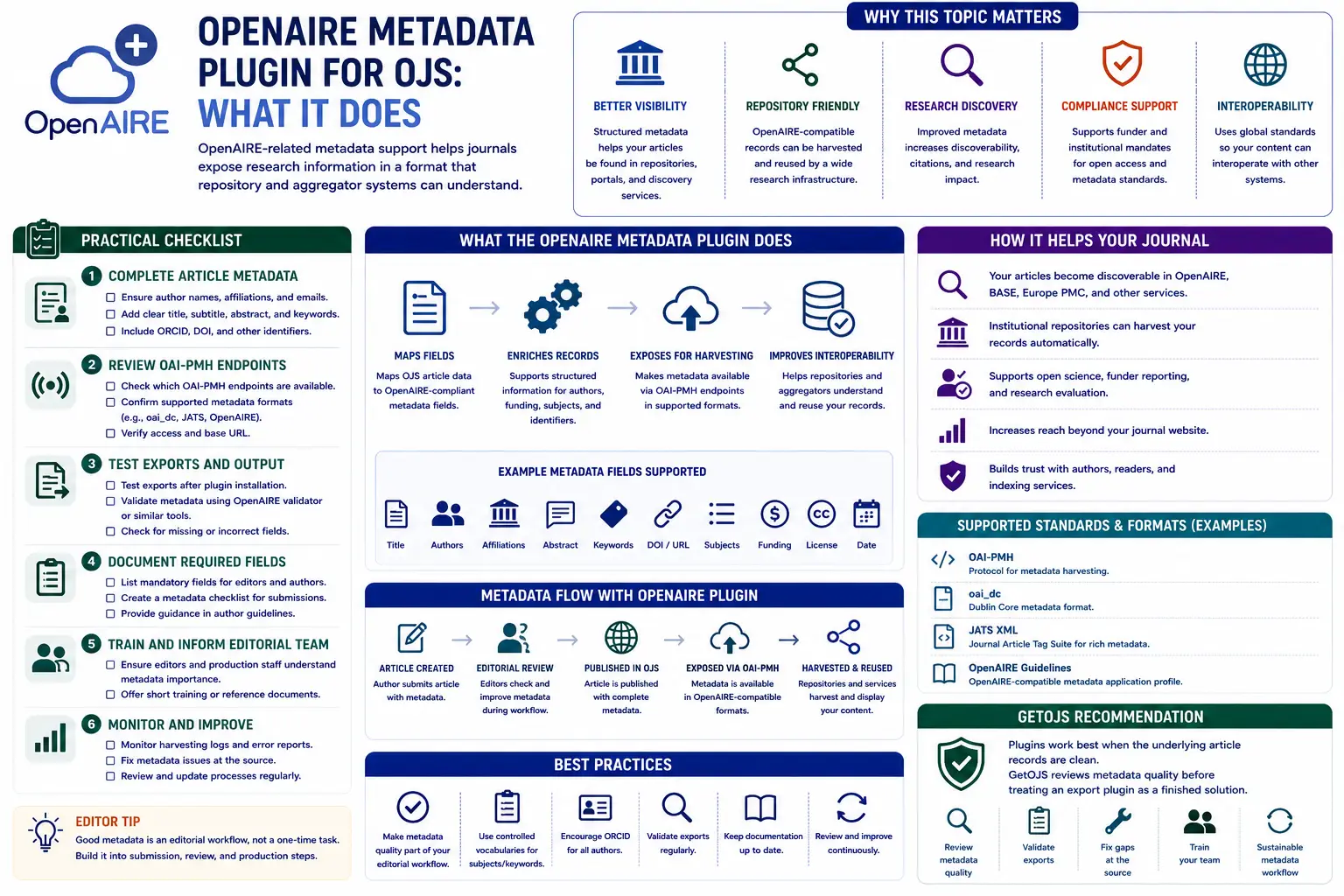
OpenAIRE-related metadata support helps journals expose research information in a format that repository systems, research aggregators, discovery platforms, and institutional networks can understand. For an OJS journal, the plugin is not only a technical add-on. It is part of a wider metadata quality process that helps published articles become easier to harvest, verify, connect, and reuse.
Introduction
Many journal teams think of publication only as the visible article page: title, abstract, PDF, authors, references, and download button. But behind every discoverable article there is another layer that matters just as much: metadata. Metadata is the structured information that tells external systems what the article is, who wrote it, when it was published, which journal published it, what identifiers are attached to it, what license applies, and how the record can be accessed. In Open Journal Systems, this information is stored across submission records, publication settings, issue details, galleys, identifiers, keywords, references, and journal-level configuration.
The OpenAIRE Metadata Plugin for OJS is useful because it helps prepare or expose metadata in a way that can be useful for repository-style discovery and harvesting workflows. OpenAIRE is connected with open science, research visibility, funder reporting, institutional repositories, and metadata exchange. A journal that wants its articles to travel beyond its own website should not depend only on page design or search engine indexing. It should also maintain clean structured metadata that external systems can read consistently.
For editors, journal managers, publishers, and technical teams, the most important point is simple: the plugin can support metadata exposure, but it cannot automatically fix poor journal data. If author names are incomplete, abstracts are missing, ORCID IDs are not collected, DOI details are wrong, affiliations are unclear, or licenses are not configured properly, the export output may still be weak. The plugin works best when the journal already follows a disciplined metadata workflow.
Why OpenAIRE-Style Metadata Matters
Research visibility depends on more than publishing a PDF. A published article may be academically strong, but if its metadata is incomplete or difficult to harvest, external platforms may not represent it correctly. Repository systems, indexing services, libraries, funder portals, and institutional dashboards often rely on structured metadata rather than manually reading article pages. This means the journal must provide accurate machine-readable information.
- Metadata harvesting depends on structured fields, not only attractive article pages.
- Repository-friendly exports help research outputs move beyond the journal website.
- Better metadata supports funder, institution, library, and discovery workflows.
- Clean metadata improves trust because records are easier to verify and connect with identifiers.
OpenAIRE-style metadata is especially helpful for journals that publish funded research, institutional research, open access content, conference proceedings, multidisciplinary articles, or work that needs to be connected with repositories. It can help make article records more reusable for systems that collect and display research output. The result is not only technical convenience. It can also support better author satisfaction, stronger journal visibility, and a more professional publishing operation.
What the Plugin Usually Helps With
The exact behavior may depend on the OJS version, plugin version, local configuration, and journal workflow, but in general an OpenAIRE metadata plugin is used to support metadata exposure aligned with repository and open science discovery needs. It may help provide an export or metadata format that includes important article details in a structured way. This can include article title, authors, publication date, abstract, journal title, issue information, DOI, language, license, identifiers, and access information.
For a journal manager, the plugin should be viewed as a bridge between OJS records and external metadata consumers. It does not replace Crossref DOI deposit, Google Scholar visibility, XML production, indexing applications, or editorial quality control. Instead, it supports one part of the larger discovery ecosystem. A good journal setup usually has multiple metadata layers working together: OJS article metadata, DOI metadata, OAI-PMH exposure, sitemap, schema markup, citation metadata, and clean public article pages.
This is why a plugin installation should not be treated as a one-click completion step. After installation, the team should review actual exported records, check sample articles, validate required fields, and confirm that the plugin output matches the journal’s publishing goals. The best result comes when the technical setup and editorial data entry process are aligned.
Metadata Fields to Review Before Installation
Before enabling or testing the OpenAIRE Metadata Plugin, the journal should review the quality of its existing article records. Many OJS journals have older articles imported from previous systems, manually uploaded back issues, missing abstracts, inconsistent author names, duplicate affiliations, incomplete references, or PDFs without proper metadata. These issues may not be visible during normal reading, but they become obvious when metadata is exported.
- Article titles: Check spelling, capitalization, special characters, and multilingual title fields where applicable.
- Author names: Use consistent first name, middle name, last name, and public display formatting.
- Affiliations: Add full institutional details instead of short or unclear text.
- Abstracts: Ensure every published article has a clean abstract in the correct language field.
- Keywords: Use meaningful keywords separated correctly and avoid keyword stuffing.
- DOI and identifiers: Confirm that DOI values are correct, active, and consistently formatted.
- License: Display open access license details clearly on article pages and metadata records.
If these fields are incomplete, the plugin may still generate output, but the output will not be strong. For example, if a journal publishes articles without author affiliations, external systems may not be able to connect research output to institutions. If DOI values are missing or wrongly formatted, article identity becomes weaker. If abstracts are empty, discovery platforms may show thin records. If license information is unclear, reuse conditions become difficult to understand.
How It Connects With OAI-PMH and Harvesting
OJS includes support for metadata exposure through OAI-PMH, which is commonly used by repositories and harvesting systems. OAI-PMH allows external services to request and collect metadata records from a journal in a structured way. The OpenAIRE-related metadata support can be valuable when a journal wants its output to be compatible with certain repository-friendly expectations and metadata formats.
For technical teams, one of the first checks should be the journal’s OAI endpoint. The endpoint should load correctly, should not be blocked by security rules, should not return server errors, and should expose the expected metadata formats. If the site has firewall rules, Cloudflare restrictions, bad redirects, locale issues, or broken base URL settings, harvesting may fail even if the plugin is installed correctly. This is why testing should include both the OJS admin side and the public metadata endpoint.
It is also important to test more than one article. A single successful record does not prove that the whole journal is clean. Test a recent article, an older article, an article with multiple authors, an article with special characters, an article with DOI, an article without DOI, and an article from a different issue. This gives a better picture of how reliable the exported metadata is across the full archive.
Practical Checklist for Journal Teams
The following checklist can help editors, journal managers, and technical staff review the plugin in a practical way before treating it as ready for production.
- Confirm that the plugin version supports your exact OJS version.
- Install and test the plugin on a staging copy before applying changes to the live journal.
- Review author names, affiliations, abstracts, keywords, references, and identifiers.
- Check which OAI-PMH endpoints and metadata formats your journal exposes.
- Open sample metadata records and check whether required fields are appearing correctly.
- Test articles from different issues, years, sections, and submission types.
- Document metadata requirements for editors and production staff.
- Keep a backup before changing plugins, templates, or production settings.
Common Mistakes to Avoid
One common mistake is installing the plugin without reviewing existing data. The journal team may assume that installation alone will improve visibility, but external systems can only read what the journal provides. If the article records are incomplete, the metadata output will also be incomplete. Another mistake is testing only the homepage or article page instead of testing the actual export format. A good-looking article page does not guarantee that machine-readable metadata is correct.
Another issue is ignoring version compatibility. OJS plugins are sensitive to major version changes. A plugin built for one OJS branch may not behave correctly on another branch. This is especially important during upgrades from older OJS versions to newer releases. Always check compatibility, review error logs, and avoid installing unverified code directly on a live journal.
Journals should also avoid enabling too many metadata-related plugins without understanding their roles. Some plugins may overlap, some may change output formats, and some may add fields that editors are not trained to maintain. A smaller, well-tested plugin stack is often better than a large set of unused or poorly documented plugins.
Benefits for Authors, Editors, and Publishers
When implemented properly, OpenAIRE-style metadata support can benefit multiple groups. Authors benefit because their work becomes easier to discover, connect, and cite. Editors benefit because journal records become more consistent and professional. Publishers benefit because the journal becomes more prepared for indexing, harvesting, institutional reporting, and long-term preservation workflows.
For open access journals, metadata quality is part of credibility. Readers may see the article page, but libraries, repositories, and indexing systems depend on structured records. A journal with clean metadata shows that it is managed carefully. This can help when communicating with institutions, applying for indexing services, improving SEO, or demonstrating publishing standards to stakeholders.
GetOJS Recommendation
Plugins work best when the underlying article records are clean. GetOJS reviews metadata quality before treating an export plugin as a finished solution. For the OpenAIRE Metadata Plugin, the recommended approach is to start with a staging review, check OJS compatibility, inspect real exported records, fix missing metadata fields, test harvesting behavior, and then document the workflow for the editorial team.
A plugin should not create confusion for editors or increase maintenance risk for the technical team. The goal is to make the journal more discoverable, more structured, and more reliable. When metadata quality, plugin configuration, and OJS maintenance are handled together, the journal is in a much stronger position for open science visibility and long-term research dissemination.
Need help applying this to your journal?
Our team can help configure, migrate, secure, customize, or maintain your OJS journal website.