
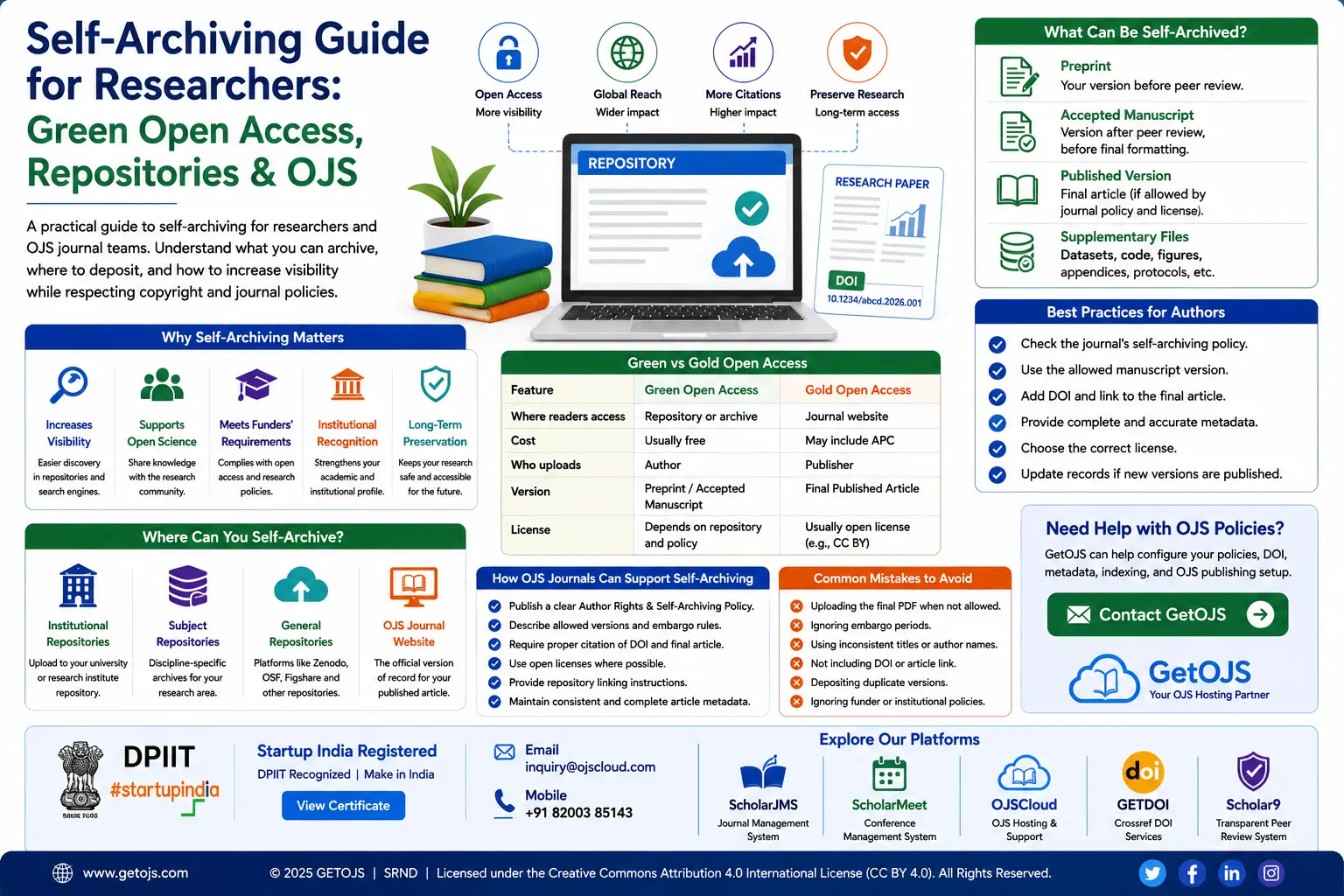
Self-archiving is one of the most practical ways for researchers to increase access to their work. For journal teams using Open Journal Systems, it is also an important policy area that affects author rights, repository visibility, DOI linking, indexing, and long-term research impact.
What is self-archiving?
Self-archiving means that an author deposits a version of a research output in an online repository, institutional archive, subject repository, personal profile, or approved public platform. The goal is to make the work easier to discover and access, even if the official journal version is hosted elsewhere. In simple terms, it allows readers to find a lawful copy of the research without depending only on the journal website.
This practice is closely connected with green open access. Under green open access, the author may archive a version of the manuscript while the journal still maintains the formal published record. That archived version may be a preprint, accepted manuscript, dataset, supplementary file, or sometimes the final published article, depending on the publisher policy and license.
Why self-archiving matters in 2026
Research discovery has changed. Scholars no longer rely only on library catalogues or journal homepages. They search through Google Scholar, Crossref metadata, institutional repositories, preprint servers, AI-powered search tools, research knowledge graphs, and indexing platforms. If a paper is available only as a hidden PDF inside a poorly configured website, it may not reach the audience it deserves.
Self-archiving improves visibility by creating additional discovery paths. A properly deposited manuscript can be found through repository search, DOI links, author profiles, funder portals, and academic search engines. For early-career researchers, this is valuable because wider access can lead to more reading, more discussion, and potentially more citations. For institutions, self-archiving supports open science, public access, and research accountability.
Self-archiving vs gold open access
Many authors confuse self-archiving with open access publishing. They are related, but they are not the same. Gold open access usually means the final published article is openly available on the journal or publisher website. In some cases, the author or institution pays an article processing charge. Green open access means a version of the work is deposited in a repository. The journal may still be subscription-based, hybrid, or fully open access.
| Model | Where readers access the work | Common cost | What authors should check |
|---|---|---|---|
| Gold Open Access | Journal or publisher website | May include APC | License, APC, copyright terms |
| Green Open Access | Repository or archive | Usually free | Allowed version, embargo, repository rules |
| Preprint Sharing | Preprint server | Usually free | Target journal preprint policy |
Which version of a paper can be archived?
The most important question is not “Can I self-archive?” but “Which version can I self-archive?” Manuscripts pass through several stages, and each stage may have different rights attached to it.
- Preprint: The version before peer review. Many authors own this version, but target journal policies should still be checked.
- Accepted manuscript: The version accepted after peer review but before final journal formatting. This is often called the author accepted manuscript.
- Published version: The final formatted article with journal layout, pagination, branding, and DOI. This version may have stricter rules.
- Supplementary files: Datasets, code, figures, protocols, appendices, and supporting material may be archived separately.
Journal teams should describe these versions clearly in their author guidelines. If the policy is unclear, authors may either avoid archiving completely or deposit the wrong version. Both situations are harmful. A clear policy protects the journal, supports authors, and reduces unnecessary email queries.
Where can researchers self-archive?
There are several places where researchers may deposit their work. The right choice depends on discipline, funder requirements, institutional policy, and the type of research output.
1. Institutional repositories
Many universities and research institutes maintain repositories for faculty, scholars, and students. These repositories are useful because they are connected to the institution’s identity and may be maintained for long-term preservation. Authors should check whether their university library or research office provides this service.
2. Subject repositories
Some fields have well-known subject repositories. For example, disciplines such as physics, mathematics, computer science, life sciences, medicine, economics, and social sciences may have dedicated archives. Subject repositories are valuable because researchers in that field already know where to search.
3. General research repositories
General repositories allow many types of research outputs, including articles, datasets, presentations, software, reports, and supplementary files. These platforms are especially helpful when a researcher does not have access to an institutional repository.
4. OJS journal website
An OJS journal itself is not always called a repository, but it plays a central role as the official publishing platform. OJS stores the article record, metadata, abstract, author information, publication date, PDF or HTML galley, DOI, issue details, and indexing metadata. For journals that support open access, the OJS article page should remain the authoritative version of record.
How OJS journals can support self-archiving
Open Journal Systems gives journal managers a strong foundation for open access publishing, but the policy layer must be written carefully. A journal should not assume that authors understand repository rules. It should publish plain-language guidance that answers practical questions.
- State whether authors may archive preprints, accepted manuscripts, or published versions.
- Explain any embargo period before repository deposit.
- Require proper citation of the published article and DOI when available.
- Clarify license terms such as Creative Commons licenses.
- Encourage authors to link repository records back to the OJS article page.
For GetOJS clients, we usually recommend adding an “Author Rights and Self-Archiving Policy” page under the journal’s About or Policies menu. This page can also be linked from Author Guidelines, Submission Checklist, Copyright Notice, and Publication Ethics pages.
Self-archiving and DOI links
A DOI helps connect different versions of research output. If the official OJS article has a DOI, the repository record should cite and link to that DOI. This helps readers identify the final version of record. It also helps indexing systems understand that the repository copy and journal article are related, not separate unrelated works.
For journals using OJS, DOI consistency is important. The DOI should appear on the article page, PDF first page, citation block, metadata export, and Crossref or other registration deposits. If the author uploads a repository copy, the DOI should be included in the repository metadata wherever possible.
Common mistakes in self-archiving
Self-archiving is useful, but mistakes can create copyright, indexing, and version-control problems. Authors and journal teams should avoid these common issues:
- Uploading the final published PDF when the journal allows only the accepted manuscript.
- Depositing a preprint without checking whether the target journal accepts previously shared work.
- Using inconsistent titles, author names, or dates between OJS and the repository.
- Forgetting to include the DOI or final article link in the repository record.
- Not checking funder or institution open access requirements.
Best practices for authors
Authors should keep a clean record of manuscript versions. The file submitted to the journal, the revised version, the accepted manuscript, and the final published article should be stored separately. Each version should have a clear filename and date. Before depositing anything in a repository, authors should read the journal’s copyright and self-archiving policy.
When uploading to a repository, authors should complete the metadata carefully. Good metadata includes title, authors, affiliations, abstract, keywords, publication date, journal name, DOI, license, funder information, and related identifiers. Metadata quality matters because AI search tools and academic discovery systems rely on structured information to understand and recommend research content.
Best practices for OJS journal managers
Journal managers should treat self-archiving as part of the publishing workflow, not an afterthought. The journal should have a written policy, consistent metadata, stable URLs, and clear DOI display. If the journal publishes under an open license, that license should be visible on article pages and PDFs.
OJS managers should also review article metadata before publication. Missing abstracts, incomplete author affiliations, broken DOI links, or inconsistent titles can reduce discovery quality. When a repository record links back to a clean OJS article page, the journal benefits from better trust and better visibility.
GetOJS recommendation
For OJS journals, the best approach is to support self-archiving with clarity. Do not leave authors guessing. Add a simple policy page, define allowed manuscript versions, explain embargo rules, include DOI citation instructions, and keep article metadata clean. This helps authors share their work responsibly while preserving the journal’s version of record.
If your journal is still setting up its policies, GetOJS can help configure your OJS website, author guidelines, copyright statement, DOI display, metadata fields, repository-friendly pages, and indexing preparation. A clear self-archiving policy improves author confidence and makes your journal look more professional to readers, reviewers, institutions, and indexing evaluators.
Frequently asked questions
Is self-archiving legal?
Self-archiving is legal when it follows the journal’s copyright, license, and repository policy. Authors should check which version is allowed and whether an embargo applies.
Can authors archive the final PDF from OJS?
That depends on the journal policy. Open access journals may allow it under a Creative Commons license, while other journals may allow only the accepted manuscript.
Does self-archiving replace journal publication?
No. Self-archiving improves access, but the journal article remains the formal version of record when it has been peer reviewed, copyedited, published, and assigned issue or DOI details.
Should repository copies link to the OJS article?
Yes. Repository records should link to the final OJS article page and DOI whenever available. This improves version clarity and helps readers find the official published record.
Need help preparing your OJS journal policies?
GetOJS can help configure author guidelines, self-archiving policy pages, DOI display, metadata quality, indexing readiness, and OJS workflow settings.