
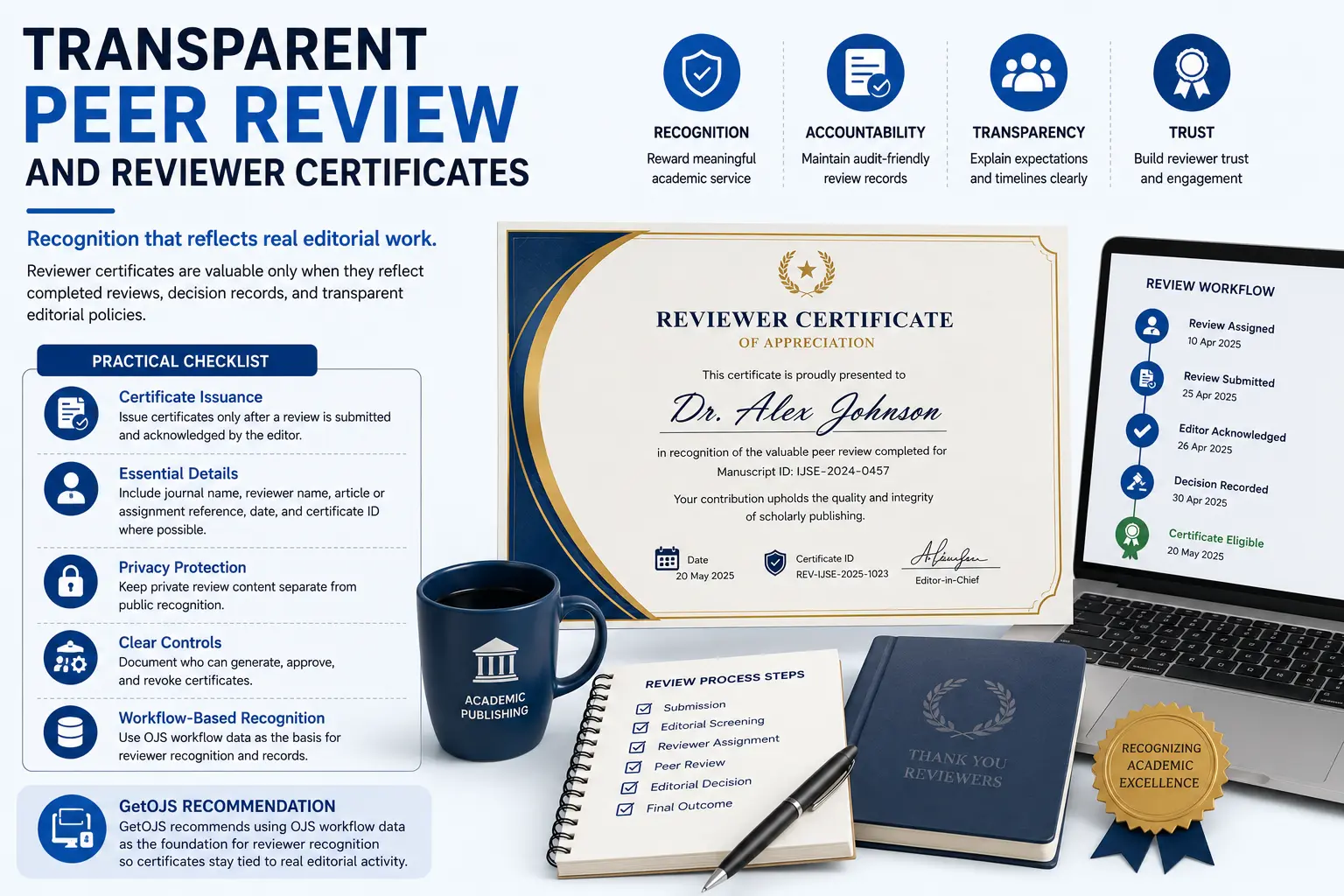
Transparent peer review is becoming an important part of modern scholarly publishing. Authors want to understand how their work is evaluated, reviewers want proper recognition for their academic service, and editors need reliable records that prove every decision followed a fair process. Reviewer certificates can support this trust, but only when they are linked to genuine completed reviews, clear editorial policies, and secure journal workflow records.
What is Transparent Peer Review?
Transparent peer review means that a journal clearly explains how manuscripts are checked, reviewed, revised, accepted, or rejected. It does not always mean that reviewer names or review reports must be made public. Instead, transparency means that authors, reviewers, editors, institutions, and indexing bodies can understand the journal's process, timeline, responsibilities, and decision standards.
For example, a transparent journal explains whether it follows single-blind, double-blind, open, or post-publication peer review. It also explains how reviewers are selected, how conflicts of interest are handled, how many reviewers are normally assigned, how revisions are managed, and how final editorial decisions are made. When these steps are visible, the journal appears more credible and professionally managed.
Why Transparent Peer Review Matters for Journals
Peer review is the foundation of academic publishing. A journal may have a good website, professional design, and strong indexing goals, but without a trustworthy review system, it cannot build long-term academic reputation. Transparent peer review helps journals demonstrate that published articles are not accepted casually or without expert evaluation.
- It builds author confidence by explaining what happens after submission.
- It supports editorial accountability through clear review records.
- It helps reviewers understand their responsibilities and timelines.
- It improves journal credibility for universities, researchers, and indexing databases.
- It reduces confusion, repeated emails, and disputes during the editorial process.
The Role of Reviewer Certificates
Reviewer certificates are formal recognition documents issued to peer reviewers after they complete a genuine review assignment. They are useful for academic profiles, institutional records, promotion files, annual performance reports, and professional portfolios. Many reviewers contribute valuable time without payment, so certificates are a practical way to acknowledge their scholarly service.
However, certificates must be issued carefully. A reviewer certificate should not be treated like a simple participation document. It should represent real editorial contribution. If certificates are generated without verification, the journal may lose trust. A proper reviewer certificate should be connected to the journal name, reviewer name, completed assignment, review date, certificate ID, and editorial confirmation.
What Should a Reviewer Certificate Include?
A professional reviewer certificate should be clear, verifiable, and consistent with the journal's recognition policy. It should not reveal confidential manuscript information unless the journal has permission and follows an open peer review model.
- Journal name and publisher or society name.
- Reviewer full name exactly as recorded in the journal system.
- Review completion date or certificate issue date.
- Certificate number, verification code, or unique certificate ID.
- Signature or approval from editor, editor-in-chief, or editorial office.
- Clear statement that the certificate recognizes peer-review service.
Keep Review Content Private and Recognition Public
One important rule for reviewer certificates is to separate private review content from public recognition. The reviewer's comments, recommendation, manuscript details, author identity, and confidential editorial discussion should remain protected unless the journal's peer review policy allows public disclosure. In many cases, the safest approach is to issue a certificate that recognizes the reviewer's service without exposing sensitive manuscript information.
This balance allows journals to appreciate reviewers while protecting authors, editors, and the integrity of the review process. It also helps journals avoid accidental privacy problems or conflicts with double-blind review policies.
Transparent Peer Review Workflow: Step-by-Step
A strong peer review workflow should be documented from submission to decision. In Open Journal Systems (OJS), journals can manage this process through submission stages, review rounds, reviewer assignments, editorial decisions, revision requests, copyediting, production, and publication.
- Initial screening: The editor checks scope, formatting, plagiarism, ethics statements, and basic manuscript quality.
- Reviewer selection: Qualified reviewers are selected based on subject expertise and conflict-of-interest checks.
- Review invitation: Reviewers receive clear instructions, timeline, and evaluation criteria.
- Review submission: Reviewers submit comments, recommendations, and confidential notes where applicable.
- Editorial decision: Editors decide whether to accept, request revision, resubmit for review, or reject.
- Recognition: Certificates are issued only after the review is completed and confirmed.
Benefits for Authors
Authors benefit from transparent peer review because they know what to expect after submission. A clear process reduces anxiety and improves communication. When journals explain review timelines, revision expectations, and decision categories, authors are more likely to trust the publication process even when revisions or rejection occur.
Transparent policies also help authors understand that peer review is not only a judgment but a quality improvement process. Helpful reviewer comments can strengthen methodology, improve clarity, correct references, refine analysis, and improve the overall impact of the research article.
Benefits for Reviewers
Reviewers invest time and expertise in evaluating manuscripts. Proper recognition encourages them to continue supporting the journal. Reviewer certificates, annual reviewer acknowledgements, verified reviewer profiles, and thank-you letters can make the review process more rewarding.
When reviewers know that the journal respects their time, provides clear guidelines, protects confidentiality, and recognizes completed assignments, they are more likely to accept future invitations and submit reviews on time.
Benefits for Editors and Publishers
Editors and publishers benefit from transparent review records because they create a reliable audit trail. This is useful for journal governance, editorial board evaluation, indexing applications, quality assurance, and dispute resolution. A journal with clear review documentation can show that editorial decisions are based on expert assessment rather than informal approval.
For publishers managing multiple journals, standardized review policies also make training easier. Editorial teams can follow the same rules for reviewer invitations, certificate approval, review reminders, and decision communication.
Common Mistakes Journals Should Avoid
- Issuing reviewer certificates before the review is completed.
- Publishing reviewer names without consent.
- Using unclear or inconsistent peer review timelines.
- Failing to document reviewer conflicts of interest.
- Generating certificates without certificate IDs or verification records.
- Mixing private review comments with public recognition content.
How OJS Supports Reviewer Recognition
Open Journal Systems helps journals manage peer review through structured editorial workflows. Editors can assign reviewers, send reminders, track review status, receive recommendations, make decisions, and preserve communication history. This workflow data can become the foundation for reliable reviewer recognition.
Instead of manually tracking reviewer service in spreadsheets, journals can use OJS records to confirm whether a reviewer accepted an assignment, submitted the review, and completed the task within the required timeline. This improves accuracy and reduces the risk of issuing certificates incorrectly.
Best Practices for Reviewer Certificate Policy
Every journal should publish a short reviewer recognition policy. This policy should explain when certificates are issued, who approves them, what information appears on the certificate, and whether certificates can be verified online. The policy should also explain that certificates do not reveal confidential manuscript content.
- Issue certificates only for completed and accepted review reports.
- Maintain a secure certificate ID or verification system.
- Use a standard certificate design for all reviewers.
- Require editorial approval before certificate generation.
- Keep certificate records connected to reviewer history.
Transparent Review and Journal SEO
Transparent peer review also supports journal SEO and online trust. When a journal website includes clear pages for peer review policy, reviewer guidelines, editorial process, publication ethics, and reviewer recognition, search engines and users can better understand the journal's credibility. These pages also help authors searching for terms such as peer reviewed journal, reviewer certificate, transparent peer review, OJS reviewer workflow, and academic publishing ethics.
For better visibility, journals should use descriptive page titles, structured headings, internal links, clean URLs, and schema where appropriate. A well-explained peer review page can become an important trust-building page for authors, reviewers, institutions, and indexing evaluators.
GetOJS Recommendation
GetOJS recommends using OJS workflow data as the basis for reviewer recognition so certificates stay tied to real editorial activity. Journals should avoid manual or informal certificate generation and instead create a controlled process based on completed reviews, editor approval, certificate IDs, and clear recognition policies.
If your journal wants to improve transparency, reviewer trust, editorial workflow, or certificate management, start by reviewing your current peer review policy and checking whether your OJS setup properly records each review stage.
Frequently Asked Questions
What is a reviewer certificate?
A reviewer certificate is a formal document that recognizes a reviewer's academic service after completing a peer review assignment for a journal.
Should every reviewer receive a certificate?
A certificate should normally be issued only after the reviewer completes and submits a meaningful review that is acknowledged by the editor.
Does transparent peer review reveal reviewer names?
Not always. Transparent peer review can simply mean that the journal clearly explains its review process, decision rules, timelines, and recognition policies.
Can OJS help manage reviewer certificates?
OJS can help maintain reviewer assignment and completion records. These records can be used as the basis for certificate approval and reviewer recognition.
Why are certificate IDs important?
Certificate IDs help verify authenticity, reduce misuse, and create a reliable record for journal administrators and reviewers.
Need help applying this to your journal?
Our team can help configure, migrate, secure, customize, or maintain your OJS journal website.