
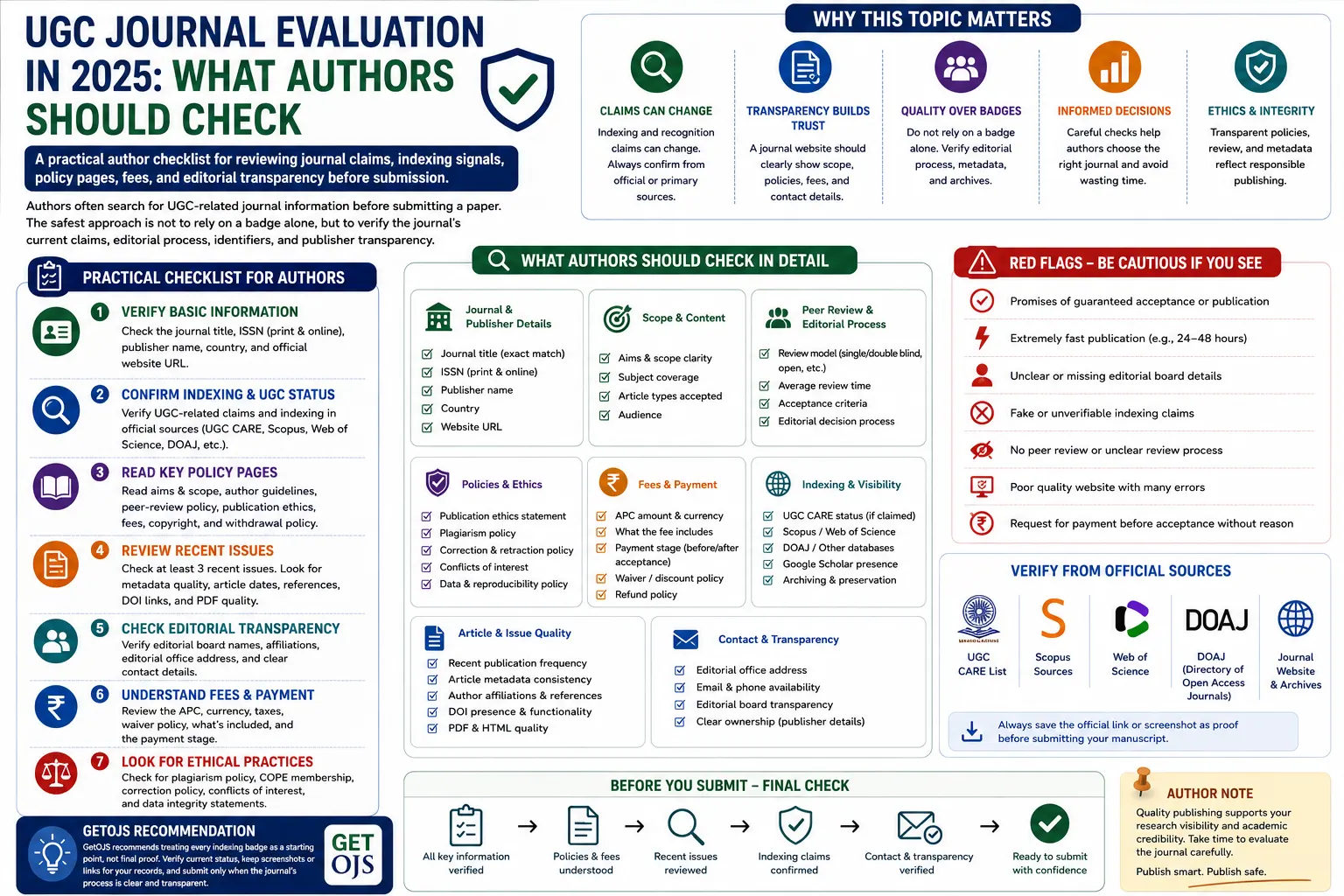
UGC journal evaluation in 2025 is no longer only about checking whether a journal name appears in a list. Authors now need a more careful and practical verification process. The safest approach is to review the journal’s peer review process, editorial transparency, indexing claims, ISSN details, publication ethics, article quality, publication fees, and publisher identity before submitting a manuscript.
Why journal evaluation matters in 2025
For many Indian authors, journal selection is connected with Ph.D. submission, academic promotion, research appraisal, funding records, and institutional performance. A publication can support an author’s academic profile only when the journal is credible, transparent, and accepted by the relevant institution. This is why authors should not rely only on promotional claims such as “UGC approved,” “peer reviewed,” “indexed,” or “fast publication.”
Journal evaluation has become more important because misleading journals, cloned journals, fake indexing claims, and unclear publication practices are still common. Some journals use old certificates, outdated indexing logos, copied editorial boards, fake impact factors, or confusing approval claims to attract authors. A careful author should verify all claims from official or primary sources before paying any publication fee.
Do not depend only on one badge or one list
In the past, many authors searched for journal lists and selected a journal only because it appeared in a recognized source. In 2025, this approach is not enough. A journal may change its publisher, website, title, frequency, indexing status, or editorial policy. Some journals may have been recognized earlier but may not meet current expectations. Others may use a similar name to appear trustworthy.
Authors should treat every badge, logo, and claim as a starting point, not final proof. A journal website may show UGC, Scopus, Web of Science, Crossref, Google Scholar, DOAJ, or other indexing names, but the author should verify the journal directly from the original database or source wherever possible. If a claim cannot be verified, it should not be treated as confirmed.
Check the journal title, ISSN, and publisher name
The first step in journal evaluation is identity verification. Authors should check the exact journal title, print ISSN, online ISSN, publisher name, country, subject area, and website URL. Many journals have similar names, especially titles beginning with words such as “International Journal of,” “Advanced Research,” “Scientific Studies,” or “Multidisciplinary Research.” A small title difference can lead to confusion.
ISSN details are especially important. If the journal website shows one ISSN and the indexing database shows another, authors should verify whether both belong to the same journal. The publisher name and journal website should also match the information available in indexing records, DOI records, and article metadata. If there is a mismatch, authors should investigate further before submission.
Verify peer review before submission
A credible journal should clearly explain its peer review process. Authors should check whether the journal follows single-blind review, double-blind review, open review, or another review model. The journal should mention how manuscripts are screened, how reviewers are selected, how revisions are handled, and how final editorial decisions are made.
Be cautious if the journal promises guaranteed acceptance, same-day acceptance, or publication without review. Fast processing is possible, but it should not replace proper editorial evaluation. A genuine peer-reviewed journal may reject weak papers, request revisions, ask for ethical clarification, or suggest improvements before acceptance. These steps are signs of a responsible journal.
Review the editorial board
The editorial board should be visible, relevant, and verifiable. Check the editor-in-chief, associate editors, section editors, and advisory board members. Their affiliations and subject expertise should match the journal’s scope. For example, a journal in engineering should have engineering experts, while a management journal should include scholars from management, business, economics, or related fields.
Authors should be careful if the editorial board page is missing, incomplete, outdated, or filled with unrelated names. Fake journals sometimes copy editor names from legitimate journals. A quick online search of editor names and affiliations can help confirm whether the board is genuine.
Check publication ethics and policy pages
Publication ethics are a major part of journal quality. A responsible journal should have clear policies on plagiarism, duplicate submission, authorship, conflicts of interest, research misconduct, data fabrication, corrections, retractions, complaints, and appeals. These policies should be easy to find on the website.
Authors should also check whether the journal explains copyright, licensing, archiving, open access policy, publication frequency, and article withdrawal rules. If a journal has no ethics policy or only uses generic copied text, it may not be professionally managed. Good policy pages show that the publisher understands academic responsibility.
Verify indexing claims from official sources
Indexing is one of the most common reasons authors choose a journal. However, indexing claims should always be verified. If a journal claims Scopus coverage, search by title and ISSN in official Scopus source information. If it claims Web of Science coverage, verify it through official Web of Science journal search tools. If it claims inclusion in other databases, check the respective official source.
Authors should also check whether the journal is currently indexed or whether coverage has stopped. A journal may have old coverage but may not be active in the database now. Some journals display indexing logos even after removal or discontinuation. For academic use, current status is usually more important than old claims.
Inspect recent issues and published articles
A journal’s archive reveals a lot about its quality. Authors should read a few recently published articles and check whether article titles, author names, affiliations, abstracts, keywords, references, DOI links, publication dates, and PDF files are properly maintained. Consistent metadata shows that the journal is managed professionally.
Poor formatting, missing references, broken PDFs, unclear article dates, unrelated topics, or low-quality writing can be warning signs. Also check whether the journal publishes articles within its stated scope. A journal that accepts every subject without clear editorial structure may not be suitable for serious academic publication.
Understand publication fees clearly
Many journals charge article processing charges, especially open access journals. A fee is not automatically wrong, but it must be transparent. Authors should check the complete fee amount, currency, taxes, payment stage, refund policy, withdrawal policy, waiver options, and whether any extra charges apply for DOI, certificates, fast processing, extra pages, or hard copy.
Avoid journals that ask for payment before proper review or hide the fee until after acceptance. A clear fee page protects both the author and the publisher. If the journal does not explain what the fee covers, ask for written clarification before submitting.
Check contact details and publisher transparency
A reliable journal should clearly mention the publisher name, contact email, office address, support details, and responsible organization. The domain name should look professional and should match the publisher identity. Be cautious if the only contact method is a personal email address, messaging app, or anonymous form.
Authors should also check whether the journal uses a stable platform, maintains archives, provides article-level pages, and offers proper author communication. A well-maintained journal website is not the only proof of quality, but it is an important signal of professionalism.
Warning signs authors should avoid
- The journal promises guaranteed acceptance or publication within a few hours.
- The website shows UGC, Scopus, or Web of Science claims without official verification links.
- The ISSN, publisher name, or website URL does not match official records.
- The editorial board is missing, fake, unrelated, or copied from another journal.
- The journal asks for payment before peer review or hides publication charges.
- The journal uses fake impact factors, unclear certificates, or outdated badges.
Practical checklist for authors
- Confirm your university or institution’s current publication requirement.
- Verify journal title, ISSN, publisher name, website URL, and subject scope.
- Read the aims, scope, author guidelines, peer review policy, and ethics policy.
- Check indexing claims from official databases, not only from website logos.
- Review recent issues for article quality, DOI links, references, metadata, and PDF consistency.
- Check publication fee, refund policy, withdrawal policy, and payment stage.
- Save screenshots or official links as proof before submission.
GetOJS recommendation
GetOJS recommends treating journal evaluation as a complete verification process. Do not depend only on a badge, list, or claim. Authors should verify current status, check journal policies, review recent articles, and confirm publisher identity before submitting.
For journal publishers, GetOJS recommends maintaining updated OJS pages for peer review policy, editorial board, indexing and abstracting, publication ethics, author guidelines, publication fees, copyright, archiving, and contact details. Clear and updated pages help authors make informed decisions and improve trust in the journal.
Final thoughts
UGC journal evaluation in 2025 requires careful checking. Authors should look beyond simple approval claims and focus on journal quality, transparency, peer review, indexing accuracy, and ethical publishing. A good journal should make its process easy to understand and easy to verify.
Before submitting your paper, take time to confirm the journal’s identity, policies, editorial process, and indexing status. This small effort can protect your research, your money, and your academic record.
Need help applying this to your journal?
Our team can help configure, migrate, secure, customize, or maintain your OJS journal website with proper policy pages, indexing sections, editorial workflows, and transparent author information.