
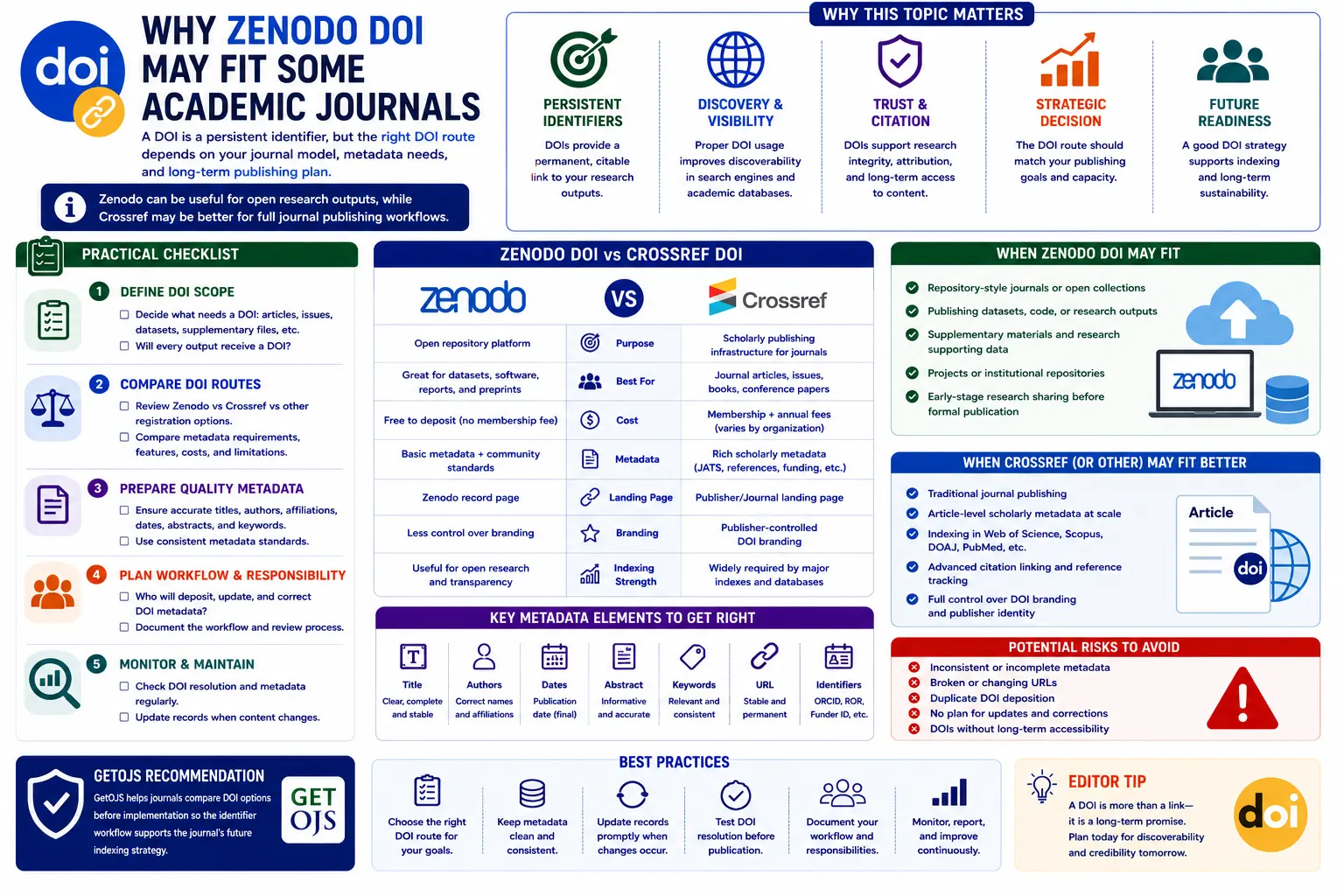
A DOI is a persistent identifier that helps readers, authors, indexing platforms, libraries, and citation tools locate scholarly content more reliably. For academic journals, DOI planning is an important publishing decision. Many journals think only about “getting a DOI,” but the better question is: which DOI workflow fits the journal’s publishing model, metadata needs, long-term maintenance capacity, and indexing goals? For some academic journals, Zenodo DOI may be a practical route. For others, Crossref or another registration workflow may be more suitable.
What Is Zenodo DOI?
Zenodo is an open research repository that allows researchers and organizations to deposit research outputs and receive persistent identifiers. It is often used for datasets, software, preprints, reports, supplementary files, presentations, and other scholarly outputs. For some academic journals, Zenodo can be useful when the journal wants to preserve and identify selected research outputs, special collections, conference proceedings, supplementary materials, or article-related files.
Zenodo DOI can be helpful for journals that do not yet have a full DOI registration infrastructure or that publish research outputs beyond standard journal articles. However, it should not be chosen only because it looks simple. The journal must still consider metadata quality, version control, article landing pages, citation format, indexing expectations, and long-term responsibility for corrections.
Why DOI Workflow Matters
A DOI is not just a number pasted on an article PDF. It is connected to metadata and a destination URL. If metadata is poor, if the DOI points to the wrong location, or if the article page changes without updating the record, the DOI workflow becomes weak. A good DOI workflow should support long-term discoverability, stable citation, and reliable access.
In OJS, article pages already contain structured information such as title, authors, abstract, keywords, publication date, issue, DOI field, galley files, and references. The DOI route should work with this structure, not against it. Whether a journal uses Zenodo, Crossref, DataCite, or another system, the editorial team should maintain clean article records.
When Zenodo DOI May Fit a Journal
Zenodo may fit journals that publish open research outputs, conference outputs, datasets, supplementary files, working papers, technical reports, or special collections. It can also help early-stage journals that want a simple DOI route while they are still planning a more formal publishing infrastructure. For small academic groups, institutional projects, research networks, or conference-linked journals, Zenodo may be practical.
- Journals that publish datasets or supplementary research files.
- Conference proceedings or special issue collections needing persistent identifiers.
- Small journals that need a basic DOI workflow before moving to a larger registration model.
- Research groups that want repository-style preservation and citation support.
- Projects where open access sharing and research output archiving are important.
When Crossref May Be Better
Crossref is commonly used by scholarly publishers for article-level DOI registration at scale. Journals that publish regular issues, need article-level citation metadata, want stronger publisher-style metadata management, or plan to meet indexing requirements may prefer Crossref. Crossref workflows are often more aligned with standard journal publishing, references, article metadata, funding metadata, and citation linking.
If a journal wants to build a long-term formal publishing program, publish many articles every year, deposit article metadata directly from OJS, and support standard citation infrastructure, Crossref may be the better route. This does not mean Zenodo is bad. It means the DOI route should match the publishing use case.
Zenodo DOI vs Crossref DOI: Practical Difference
The difference is not only technical. It is about workflow and purpose. Zenodo is repository-oriented and useful for research outputs. Crossref is publisher-oriented and widely used for journal articles, books, proceedings, and scholarly publishing metadata. A journal should decide whether it needs repository-style deposit, publisher-style article metadata, or both.
Some journals may use Crossref for published articles and Zenodo for datasets, supplementary materials, or research outputs connected to articles. This hybrid approach can work if it is documented clearly. The journal should avoid assigning multiple DOIs to the same version of the same article without a clear policy, because that can confuse citations.
Metadata Quality Is Still Required
No DOI workflow can fix poor metadata automatically. Journal teams must maintain accurate titles, author names, affiliations, abstracts, keywords, publication dates, issue details, article URLs, and PDF files. If Zenodo deposits contain incomplete information, the DOI may exist, but the scholarly record will not be strong.
Before depositing any article or file, the journal should check whether the metadata matches the OJS article page and PDF. The author order should be correct. The title should match exactly. The publication date should be consistent. The DOI destination should be stable. If metadata changes later, the record should be updated where possible.
Article Landing Page or Repository Record?
A journal must decide what the DOI should resolve to. For journal articles, many publishers prefer the DOI to point to the article landing page on the journal website. The landing page can include abstract, authors, DOI, PDF link, citation tools, references, metrics, and related metadata. For repository deposits, the DOI may point to the repository record.
If Zenodo is used, the journal should decide whether Zenodo becomes the main landing record or whether the OJS page remains the primary article page. This decision affects citation, indexing, and user experience. Readers should not be confused between the journal page and repository record.
Benefits of Zenodo DOI for Some Journals
- Useful for open research outputs, datasets, and supplementary materials.
- Can support repository-style preservation and public access.
- Helpful for small research projects and conference-linked publications.
- Can provide a practical DOI route for selected content types.
- Encourages structured metadata and long-term access planning.
Limitations to Consider
Zenodo DOI may not be the best fit for every academic journal. If the journal needs a full article-level publishing metadata workflow, Crossref may be more suitable. If the journal wants integration with standard OJS DOI deposit tools, citation linking, large-scale article deposits, or formal publisher infrastructure, Zenodo may create extra manual work.
Another limitation is consistency. If some articles receive Zenodo DOI, some receive Crossref DOI, and some receive no DOI, the journal’s citation structure can become confusing. A journal should create a clear DOI policy before assigning identifiers.
OJS Workflow Considerations
In OJS, DOI planning should be part of the publication workflow. Editors should not wait until after publication to decide how identifiers will be assigned. The DOI route should be known before issue production. The team should know who creates the DOI, who enters it into OJS, who checks the PDF, and who updates metadata if something changes.
If Zenodo is used outside OJS, administrators must make sure the DOI is entered correctly into the OJS article metadata. The DOI should appear on the article page, citation display, PDF, and metadata exports where appropriate. The same DOI should not be typed differently in different places.
Use Cases Where Zenodo Works Well
Zenodo can work well for supplementary datasets linked to a journal article. For example, an article may be published in OJS, while the dataset supporting the article is deposited in Zenodo with its own DOI. This allows the article and dataset to be cited separately. It can also work for conference proceedings where the publication model is closer to repository deposit than traditional journal issue management.
Zenodo can also help with special research outputs such as software code, technical documentation, posters, research protocols, or policy reports. If the journal’s scope includes such outputs, Zenodo may be a useful addition to the publishing workflow.
Common Mistakes to Avoid
- Choosing Zenodo only because it seems easier, without checking long-term journal goals.
- Assigning different DOIs to the same article version without a clear policy.
- Depositing incomplete metadata with missing abstracts, authors, or publication dates.
- Forgetting to add the DOI back into the OJS article page and PDF.
- Using repository records when indexing systems expect journal landing pages.
- Not documenting who is responsible for DOI corrections and updates.
Questions to Ask Before Choosing Zenodo DOI
Before choosing Zenodo DOI, the journal should discuss the decision internally. DOI workflow affects publishing, indexing, citation, and long-term access. Editors, publishers, technical administrators, and indexing teams should understand the selected route.
- Will DOI assignment be for every article or only selected outputs?
- Will the DOI point to OJS article pages or Zenodo repository records?
- Does the journal need standard article-level publishing metadata at scale?
- Will datasets and supplementary files need separate identifiers?
- Who will create, verify, update, and correct DOI metadata?
- Does the selected workflow support future indexing goals?
Practical DOI Workflow Checklist
- Define whether DOI assignment is needed for articles, issues, datasets, or supplementary items.
- Compare Zenodo, Crossref, and other DOI routes before implementation.
- Keep article titles, authors, abstracts, dates, and URLs stable.
- Document DOI formatting, deposit responsibility, and correction workflow.
- Update OJS article metadata and article PDFs after DOI assignment.
- Test DOI resolution before announcing or sharing the article publicly.
- Review DOI records after migration, URL change, or journal redesign.
GetOJS Recommendation
GetOJS helps journals compare DOI options before implementation so the identifier workflow supports the journal’s future indexing strategy. Zenodo DOI may fit some academic journals, especially those working with open research outputs, datasets, conference collections, or supplementary materials. But journals with regular article publishing at scale may need Crossref or another formal publishing metadata route.
The best DOI decision is not only about cost or convenience. It should match the journal’s publishing model, metadata requirements, indexing goals, editorial capacity, and long-term maintenance plan. With clear policy, clean metadata, stable URLs, and proper documentation, journals can choose a DOI route that supports both current publishing needs and future growth.
Need help choosing the right DOI workflow for your journal?
Our team can help compare Zenodo, Crossref, OJS DOI settings, metadata workflows, DOI display, article URLs, and indexing readiness for your journal website.