
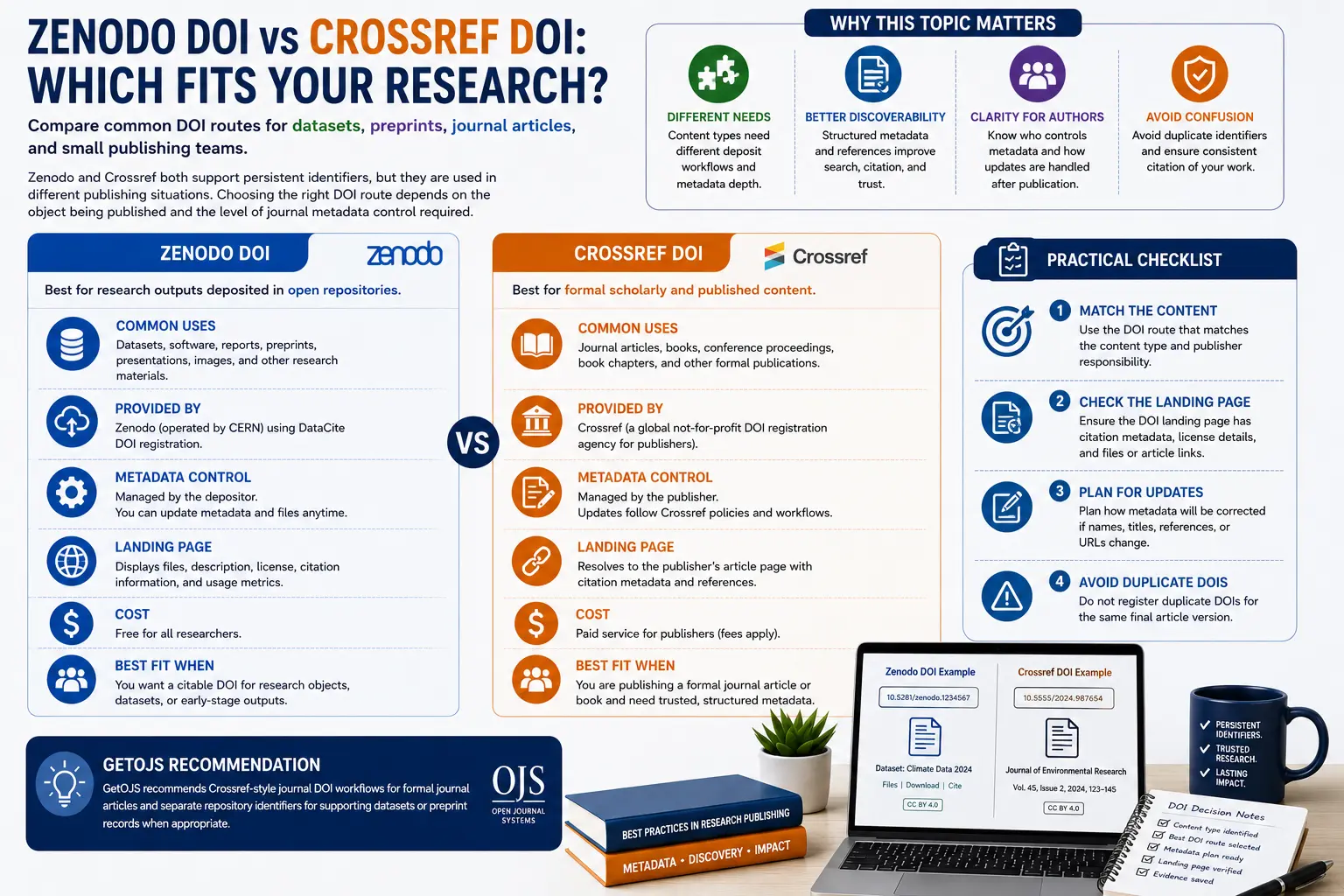
Zenodo DOI and Crossref DOI both help make research outputs easier to identify, cite, share, and preserve. However, they are designed for different publishing situations. Zenodo is often useful for datasets, software, preprints, posters, presentations, and supplementary research files, while Crossref is commonly preferred for formal journal articles, conference proceedings, books, chapters, and publisher-managed scholarly content.
What Is a DOI?
A DOI, or Digital Object Identifier, is a persistent identifier assigned to a digital research object. Instead of depending only on a normal website URL, a DOI provides a stable link that can continue to resolve even if the file or article page moves to a new location. This makes DOI registration important for academic publishing, citation management, research discovery, indexing, and long-term access.
For authors, a DOI makes research easier to cite. For publishers, it strengthens metadata quality and helps article records connect with indexing services, reference lists, institutional repositories, and scholarly databases. For readers, it provides a more reliable way to locate the correct version of a publication.
Zenodo DOI vs Crossref DOI: The Simple Difference
The simplest way to understand the difference is this: Zenodo DOI is usually repository-focused, while Crossref DOI is publisher-focused. Zenodo is a general-purpose open repository where researchers can upload and preserve research outputs. Crossref is a DOI registration agency widely used by academic publishers to register metadata for journal articles and other formal scholarly publications.
This does not mean one is universally better than the other. The right choice depends on what you are publishing, who is responsible for the record, whether the output is a formal article or supporting material, and how the metadata will be maintained in the future.
When Zenodo DOI Fits Best
Zenodo is a strong option when researchers need a DOI for research outputs that may not be published as formal journal articles. This includes datasets, code, software packages, research posters, presentation slides, technical reports, preprints, and supplementary files. It is especially useful for individual researchers, small teams, project groups, and academic institutions that want to share research materials openly.
- Datasets connected to a research paper.
- Software code, scripts, or tools used in a study.
- Preprints, working papers, posters, and presentations.
- Project outputs from funded research.
- Supplementary materials that need a stable citation link.
Zenodo is particularly helpful when the research object itself is a file or repository item. For example, if an author publishes a journal article and wants to share the dataset behind the results, Zenodo can provide a DOI for that dataset while the journal article has its own DOI through Crossref.
When Crossref DOI Fits Best
Crossref DOI is generally the better route for formal journal publishing. If you are running an academic journal, conference proceedings, book series, or scholarly publishing platform, Crossref-style metadata is more suitable because it supports structured information about articles, authors, references, publication dates, journal titles, volumes, issues, pages, funding, licenses, and relationships between research objects.
For journal publishers, Crossref DOI registration also supports professional publishing workflows. Article metadata can be deposited from the journal website, DOI links can resolve to official article landing pages, and references can be connected to citation networks. This is why many journals use Crossref DOI services for final published articles.
- Peer-reviewed journal articles.
- Conference proceedings published by an organizer or publisher.
- Books, book chapters, and edited volumes.
- Publisher-managed article pages with formal metadata.
- Research outputs that need reference linking and structured citation metadata.
Why Metadata Control Matters
One of the most important differences between Zenodo DOI and Crossref DOI is metadata control. A DOI is not just a link. It is a metadata record. The quality of that metadata affects how easily the item can be cited, indexed, discovered, and corrected later.
For a journal article, metadata usually includes title, authors, affiliations, abstract, keywords, publication date, journal title, ISSN, volume, issue, article number, references, license, and article URL. If this information changes after publication, the publisher should be able to correct and redeposit the metadata. Crossref DOI workflows are designed around this publisher responsibility.
Zenodo also allows metadata entry, but it is often controlled at the repository record level. This is suitable for datasets and independent outputs, but it may not provide the same journal-level publishing structure that a formal article record requires.
Avoid Duplicate DOI Problems
One common mistake is registering more than one DOI for the same final version of a research article. Duplicate DOIs can confuse authors, readers, indexing services, and citation databases. A preprint may have one DOI, a dataset may have another DOI, and the final article may have a Crossref DOI. That is acceptable when each DOI represents a different object or version. However, the same final published article should not usually receive multiple competing DOIs.
Before assigning a DOI, publishers should clearly define what the DOI represents. Is it the submitted manuscript, accepted manuscript, final article, dataset, software code, or conference paper? This clarity prevents citation confusion and helps maintain clean scholarly records.
DOI Landing Page Quality
Whether you use Zenodo or Crossref, the DOI should lead to a useful landing page. A strong DOI landing page should not be a blank file download. It should clearly show the title, authors, publication date, abstract or description, license, citation format, related files, and access options. For journal articles, the landing page should also include journal name, volume, issue, DOI, references, PDF, HTML article view where available, and author metadata.
A well-built landing page improves search engine visibility and user trust. It also helps indexing systems understand the object correctly. For OJS journals, the article landing page is usually the best DOI target because it contains structured article information and links to publication files.
How OJS Journals Should Handle DOI Workflows
Open Journal Systems (OJS) supports DOI workflows for journal publishing. When configured correctly, OJS can help publishers assign DOI patterns, display DOI links on article pages, manage metadata, and prepare records for deposit. This is especially useful for journals that publish regular issues and want professional article-level DOI management.
For journals using OJS, Crossref DOI is usually the most appropriate route for final article records. Zenodo can still be useful for supporting files such as datasets, replication packages, supplementary figures, or code repositories. A good workflow may use Crossref for the article and Zenodo for research materials linked from the article page.
Comparison Checklist
- Use Zenodo DOI when the output is a dataset, software package, preprint, report, poster, or supplementary file.
- Use Crossref DOI when the output is a formal journal article, proceedings paper, book chapter, or publisher-managed scholarly record.
- Check who will maintain the metadata after publication.
- Make sure every DOI resolves to a clear landing page.
- Avoid assigning duplicate DOIs to the same final article version.
- Link related objects properly, such as article, dataset, code, and supplementary material.
For Authors: Which DOI Should You Prefer?
If you are an author submitting to a journal, the journal should normally handle the DOI for the final published article. You should not independently register another DOI for the final article unless the publisher or journal policy specifically allows it. If you want to share datasets, code, or supplementary files, Zenodo can be a good option. You can then cite that dataset DOI inside your article or data availability statement.
Authors should also check whether the DOI points to the correct version. A preprint DOI should not be confused with the final published article DOI. If both exist, the records should clearly identify their relationship so readers understand which version they are viewing.
For Publishers: Which DOI Route Is More Professional?
For formal journals, Crossref DOI workflows are generally more professional because they support journal-level metadata, reference linking, publisher responsibility, and article record updates. Publishers should maintain consistent DOI patterns, clear article landing pages, and accurate metadata. They should also ensure that DOI links remain active even after website redesigns, OJS upgrades, domain changes, or journal migrations.
Small publishers and new journals should plan DOI policy early. A DOI is a long-term commitment, not just a decorative badge on the article page. Once a DOI is assigned, the publisher should maintain the landing page and metadata record responsibly.
Frequently Asked Questions
Is Zenodo DOI accepted for research publication?
Zenodo DOI can be useful for datasets, software, reports, preprints, and supplementary materials. For formal journal articles, authors should check the journal's publication policy and institutional requirements.
Is Crossref DOI better than Zenodo DOI?
Crossref DOI is usually better for formal journal articles and publisher-managed records. Zenodo DOI is often better for repository items such as datasets, code, posters, preprints, and project outputs.
Can one research project have both Zenodo and Crossref DOI?
Yes. A final article may have a Crossref DOI, while its dataset or software code may have a Zenodo DOI. The important point is that each DOI should identify a separate research object.
Can I assign two DOIs to the same article?
It is better to avoid duplicate DOIs for the same final article version because it can create citation and indexing confusion.
Conclusion
Zenodo DOI and Crossref DOI both support research visibility, citation, and long-term access, but they serve different publishing needs. Zenodo is ideal for repository-based research outputs such as datasets, code, preprints, and supplementary files. Crossref DOI is generally more suitable for formal journal articles and publisher-managed scholarly records.
For most journals, the best strategy is not to choose one system for everything. Use Crossref DOI for final journal articles and use Zenodo or similar repositories for supporting research materials when appropriate. This balanced approach improves metadata quality, reduces confusion, supports open science, and helps authors, publishers, and readers connect every research object correctly.
GetOJS Recommendation
GetOJS recommends Crossref-style DOI workflows for formal OJS journal articles and separate repository identifiers for datasets, preprints, software, or supplementary materials. This keeps article metadata clean while allowing researchers to share supporting outputs openly.
Need help applying this to your journal?
Our team can help configure DOI workflows, Crossref integration, OJS article pages, metadata deposits, journal migration, security, customization, and long-term publishing support.